Payroll Debit Cards in California: What’s the Law on Cash Alternatives?
Payroll debit cards are legal in California, but only when participation is voluntary and workers can reach their full wages in cash without a fee.

- Last updated
- Reading time
- 4 min
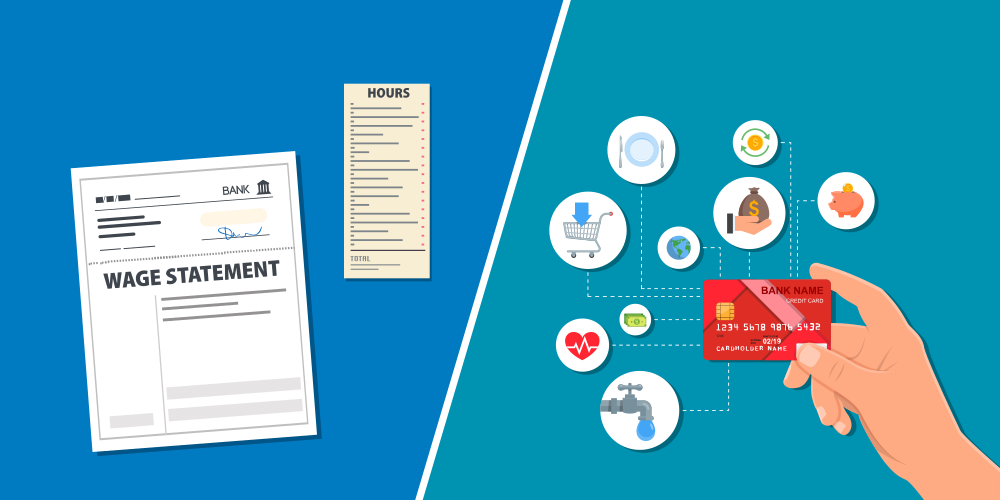
The concept of payroll debit cards is simple: rather than getting paid through cash or a check, employees receive their payments on a bank card. The employees can then use that card to spend money, like a credit or debit card. Or they can go to a bank or ATM and withdraw money to get the cash.
Paying employees with a payroll debit card is legal in California, but within limits. The card must let the employee draw the full amount of their wages in cash, on demand, and without any fee or discount, and participation has to be voluntary: an employer may offer a payroll card but cannot require one.1
Employers sometimes use these cards because they allow them to save money associated with checks. Distributing and mailing paper checks can be costly, and paying employees in cash is usually not feasible for a business. In some cases, employers may receive benefits from their bank for switching over to a payroll debit card system.
The risk in using these cards, however, is the financial burden on the workers. The use of payroll debit cards sometimes shifts all payroll costs to the employee. The banks, for instance, may charge numerous fees for using these cards, including processing fees, fees for using ATMs, and fees for inactivity. The banks may also benefit by gaining the employees as new customers.
Because the banks may gain new business from the use of payroll debit cards, they sometimes provide financial incentives for employers to issue the payroll debit cards to their employees. So it’s easy to see why the trend toward payroll debit cards is growing among employers. The rest of this guide explains how California law treats them and the limits that apply.
Cash Alternatives Are Generally Allowed

In California, the law on payroll debit cards is relatively sparse. No court cases have definitively decided whether these kinds of payments are permissible, and there is no law directly on point. Related laws, however, provide guidance on alternative payment methods.
Generally, employers must pay their employees in a form that is negotiable and payable in cash.2 A check, for instance, can be taken to a bank and cashed. Checks are therefore a method of pay that is payable in cash.
An employer may not, however, issue a form of payment that would be discounted if turned into cash.3 So, an employer cannot issue a check from a bank that will charge a fee when cashing it.
Payroll Debit Cards Must Be Freely Cashable

The form of payment the employer chooses must be able to be cashed at an established place of business in the state. For the most part, this means that the payment method must be allowed to be cashed at a bank. The name of the bank must appear on the form of payment.4 If the business cashing the payment is someone other than a bank, their address must also appear on the form of payment.5
Employers may not offer any scrip or coupon that is not redeemable in cash.6 This, in essence, prevents businesses from paying their employees with coupons that can only be used in their store, like company scrip.
Employers, or their managers and agents, may be guilty of a misdemeanor if they violate these rules.7 They could also be liable to the employees for civil damages.
Overall, however, employers are allowed to pay their employees in cash alternatives, as long as they can be turned into cash easily and without a fee. Employees must also receive an itemized paystub with their payment.8
Because employers can pay their employees in cash alternatives, they are permitted to make payments through direct deposit or through the use of payroll debit cards. In fact, the law specifically permits employers to deposit funds in a bank of the employee’s choice.9
Payroll Debit Card Programs Should Be Voluntary

The California Labor Commissioner’s Office, also known as the Division of Labor Standards Enforcement (DLSE), has stated in an opinion letter that the law does not prohibit the use of payroll debit cards.10 It is important, however, that participation in the payroll debit card program is optional for the employee.11
So, under the DLSE’s interpretation, employers may give their employees the option of using payroll debit cards, but may not require their use. Any payroll debit card program must be completely voluntary and all the details of the program should be disclosed to the employees.12
References
- Labor Code, § 212, subd. (a)(1); DLSE Opinion Letter 2008.07.07 (July 7, 2008).↥
- Labor Code, § 212, subd. (a)(1).↥
- Labor Code, § 212, subd. (a)(1).↥
- Labor Code, § 212, subd. (a)(1).↥
- Labor Code, § 212, subd. (c).↥
- Labor Code, § 212, subd. (a)(2).↥
- Labor Code, § 215.↥
- Labor Code, § 226, subd. (a).↥
- Labor Code, § 213, subd. (d).↥
- See DLSE Opinion Letter 2008.07.07 (July 7, 2008), available here.↥
- Holak v. Kmart Corp. (E.D. Cal., Dec. 12, 2012, No. 1:12-CV-00304 AWI) 2012 WL 6202298, at *6 [suggesting that “payroll debit card programs do not violate the Labor Code where the employees are fully informed of the service and it is represented as an alternative method for wage payment for which their participation is optional.”].↥
- See DLSE Opinion Letter 2008.07.07-2 (July 7, 2008), available here.↥