Pregnancy Disability Leave Law in California: A Guide to PDL
Pregnancy disability leave lets California employees take up to four months off while disabled by pregnancy or childbirth, and this guide covers eligibility, reinstatement, pay, and how to request it.

- Last updated
- Reading time
- 20 min
In California, there are generally two types of maternity leave a woman can take: pregnancy disability leave, and baby bonding leave. Of these, pregnancy disability leave is the most common because the eligibility requirements are much lower than baby bonding leave.
In general, pregnancy disability leave (PDL) is the leave a woman takes while she is disabled by her pregnancy or the childbirth. An employee who has a disability related to her pregnancy or the birth of her child can receive up to four months of maternity leave while that disability continues.1
Put simply, pregnancy disability leave is broadly available to California employees if two requirements are met:
- The employee must be disabled by her pregnancy, the childbirth, or a related medical condition;2 and
If both requirements are met, the woman can take leave while she continues to be disabled by her pregnancy, the childbirth, or a related medical condition. The leave, however, cannot exceed four months (per pregnancy).5
California’s pregnancy disability leave does not need to be taken all at once. Rather, it can be dispersed over the course of the pregnancy and childbirth.6 This can be important for women who experience conditions that are temporary or intermittent.
The rest of this article will examine these requirements, as well as other types of maternity leave a woman may wish to take.
“Disability” Defined Under the PDL Law
The most important question for women is whether they are, in fact, disabled by their pregnancy, the childbirth, or a related medical condition.7 In general, pregnancy itself is not considered a disability. But, if pregnancy-related complications arise, the employee may become legally disabled.8
A woman is disabled by her pregnancy if, in the opinion of her doctor, she is unable to perform any one or more of the essential functions of her job because of her pregnancy.9
By about the 36th week of pregnancy, most women will experience some level of physical difficulty in performing one or more of the essential functions of their job. Even sitting at a desk for long hours can be strenuous at that point. So it’s common for doctors to find their patient to be unable to work around week 36.
If there are complications, the employee might be disabled even earlier. The following conditions are commonly considered disabling for these purposes, and will entitle the employee to begin her pregnancy disability leave early:
- Severe morning sickness,
- Prenatal or postnatal care,
- The need for bed rest,
- Gestational diabetes,
- Pregnancy-induced hypertension,
- Preeclampsia,
- Post-partum depression,
- Loss or end of pregnancy, and
- Recovery from loss or end of pregnancy.10
This list of examples is not exhaustive. Employees may have a different pregnancy or childbirth-related condition that would be considered disabling enough to qualify you for maternity leave.
It goes without saying that childbirth is a physically strenuous experience. As such, pregnancy-related disabilities will continue past birth. Every woman is different, but six weeks is a typical post-birth recovery time for a vaginal birth with no complications. If a caesarean section (c-section) or any other form of traditional surgery is necessary, eight weeks (or more) of recovery time is typical.
During this recovery time, women are still considered “disabled” by their pregnancy for the purposes of California’s pregnancy disability leave law, as long as, in the opinion of her doctor, she is unable to perform one or more of the essential functions of her job because of the childbirth.11
Which Employers Are Covered by the PDL Law

Under California law, employers are required to provide pregnancy disability leave if they fall into one of the following categories:
- The employer is a person or business that regularly employs five or more people,
- The employer is a person or business who acts as an agent12 of a covered employer, or
- The employer is a state or local governmental entity.13
If the employer falls into one of these categories, they are a covered employer under California’s pregnancy disability leave law.14 As such, they must permit eligible employees to take pregnancy disability leave.15
Of note, however, certain religious nonprofit associations and corporations are not considered “employers” for these purposes. Those religious employers are thus not subject to California’s pregnancy disability leave law.16
No Additional PDL Eligibility Restrictions Are Allowed

Pregnancy disability leave is unique in that it applies to all female employees of covered employers, as long as they have a qualifying disability.17 There are no additional eligibility requirements.
This means that part-time employees are entitled to take pregnancy disability leave to the same extent as full-time employees. Similarly, there is no minimum length of service requirement to qualify for pregnancy disability leave, so even recently hired employees can take it.18
Reinstatement Rights After Pregnancy Disability Leave

The right to take time off work is meaningless if there will be no job for the employee when they return. As such, California law has adopted strong reinstatement protections for employees returning from pregnancy disability leave.
Employees who exercise their right to take pregnancy disability leave are guaranteed a right to return to the same or comparable position, unless certain exceptions apply.19 The employee may ask the employer to provide this guarantee in writing.20
The most common exception to this right occurs when the employee would not have the same or comparable position, due to legitimate business reasons, even if she hadn’t taken pregnancy disability leave.21
If there was a mass layoff, for example, then the employer may be able to show that the employee would have lost her job for legitimate business reasons unrelated to the employee taking pregnancy disability leave.
California law does not, however, allow employers to deny reinstatement on the grounds that preserving the job or duties for the employee would be inconvenient for the employer.
Other Types of Maternity Leave
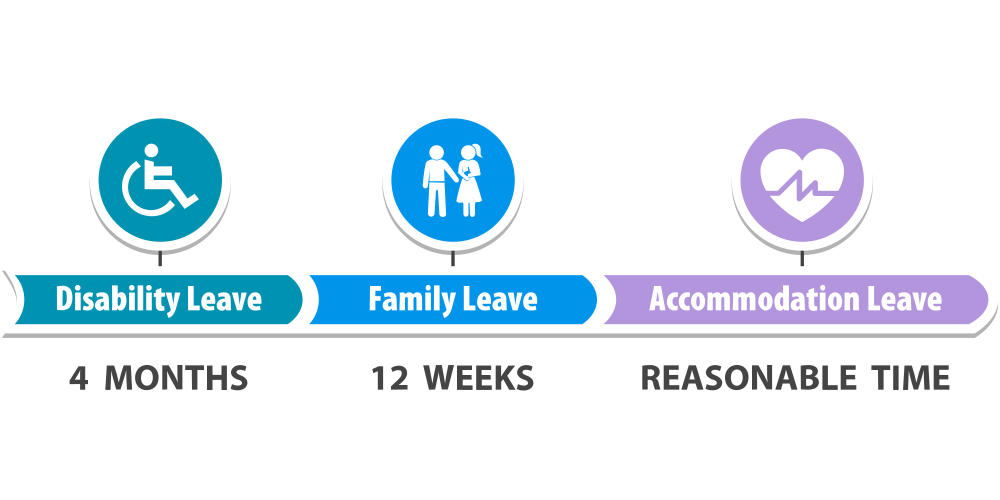
Many employees have the right to take time off during and after the birth of their child. Besides pregnancy disability leave, there are generally two types of maternity leave in California:
- Family Leave. Employees that work for employers with five or more employees are entitled to take up to 12 weeks of family leave to bond with their child.22
These types of leave can be taken consecutively, allowing many employees to enjoy up to seven months of maternity leave per pregnancy, and possibly more if additional leave time would be a reasonable accommodation for the employee’s pregnancy-related disability.25
Employees will sometimes be entitled to pay or benefits during their maternity leave. The right to pay during leave, however, is distinct from the right to take leave in the first place.
Maternity leave is therefore unpaid unless the employee has a separate legal right to pay during leave.26 The laws controlling the right to pay during maternity leave are addressed below, in the chapter on pay and benefits during maternity leave.
Family and Bonding Time Leave
Under California law, eligible employees have a right to take up to 12 weeks of family leave per year.27 This leave can be used by both men and women to bond with a new child after its birth, adoption, or foster care placement with the employee.28
To maximize the employee’s total period of maternity leave, this leave can be taken after she uses any pregnancy disability leave to which she may be entitled.29 This can allow employees to take up to seven months of maternity leave per pregnancy, depending on the duration of her pregnancy-related disabilities.30
An employee is entitled to take child-bonding leave under the California Family Rights Act (CFRA) if the following requirements are met:31
- The employer must have five or more employees;
- The employee must have worked more than 12 months for the employer prior to the date that the period of leave is taken; and
- In the past 12-month period, the employee must have worked at least 1,250 hours for the employer.32
If all three requirements are met, employers will usually be required to provide family leave for the purpose of child bonding to eligible employees.33
Taking Family Leave
Family leave does not need to be taken all at once, but it must be completed within one year of the child’s birth, adoption, or foster care placement.34
An employer can require an employee to take the leave in a minimum duration of two weeks at a time. However, the law also gives the employee two opportunities to take intermittent leave of less than two weeks at a time.35
How does this work? On two occasions, an employee can ask the employer to grant her the right to take bonding leave of less than two-week increments. Once those two opportunities have been granted, the employer can require the new-child bonding time to be taken in two week increments.
Reinstatement After Family Leave
Most employees have a guaranteed right to be reinstated with their employer when they return from family leave.36 This is true even if the employee’s position was restructured or replaced to accommodate the employee’s absence.37
The right to reinstatement means that the employee is entitled to the same or a comparable position.38 If the employer chooses to reinstate the employee in a different position, the new position must be equivalent to the employee’s former position in terms of pay, benefits, shift, schedule, geographic location, and working conditions, including privileges, perquisites, and status.39
The new position must also involve the same or substantially similar duties and responsibilities, which must entail substantially equivalent skill, effort, responsibility, and authority.40
Additionally, if an employee returns to the job and is no longer qualified for the job due to missing training or other events which happened while she was off work, she must be afforded a reasonable opportunity to fulfill those key requirements.41
Taking Leave as a Reasonable Accommodation
California law prohibits covered employers from discriminating against employees on the basis of their physical or mental disabilities.42 This protection extends to women that are disabled as a result of their pregnancy.43
As part of the rule against discrimination, California law imposes a duty on covered employers to make reasonable accommodations for employees with disabilities.44 A reasonable accommodation is an adjustment to the employee’s work environment that can enable the employee to perform the essential functions of the job.45
Importantly for the purposes of maternity leave, a “reasonable accommodation” can sometimes include a period of leave, even after other types of leave have been exhausted.46
There are four requirements for employees to be eligible for a reasonable accommodation:
- The employer must be covered by California’s anti-discrimination laws, which applies to most businesses that have five or more employees.47
- The employee must have a qualifying physical or mental disability that impairs the employee’s ability to perform the essential functions of her job.48
- If given a reasonable accommodation, the employee must be capable of performing her job’s essential functions.49
- The reasonable accommodation would not cause the employer an undue hardship.50
The definition of “covered employer” for these purposes is the same as under the pregnancy disability leave law.
What a “Reasonable Accommodation” Means
As mentioned above, a reasonable accommodation is an adjustment to the employee’s work environment that can enable the employee to perform the essential functions of the job.51
The type of adjustment will vary depending on the employee’s job and the nature of the disability.52 Whether a proposed accommodation is reasonable is a question of fact, and can be the subject of much debate.53
In general, courts are flexible in considering what accommodations are reasonable.54 And employers are required to consider “any and all” reasonable accommodations they are aware of, unless those accommodations will create an undue hardship.55
Additionally, the employer must consider the employee’s preference in deciding which kind of accommodation to select.56 Nevertheless, employers have discretion to choose between accommodations that are otherwise reasonable and effective.57
Importantly, however, employers are not required to consider an accommodation if it would prevent the employee from performing the essential functions of the job. Nor is an employer required to accommodate disabilities that would endanger the employee’s health or the health of their coworkers.58
Reasonable accommodations often involve making existing facilities readily accessible to individuals with disabilities.59 They can also include: job restructuring, reassignment to a vacant position, alterations to when tasks are to be completed, or changes to how functions are performed.60 Again, the best type of accommodation will vary from job to job.
In some cases, the employer may be required to permit the employee to take a period of leave for treatment and recovery.61 As explained by one court:
Holding a job open for a disabled employee who needs time to recuperate or heal is in itself a form of reasonable accommodation and may be all that is required where it appears likely that the employee will be able to return to an existing position at some time in the foreseeable future.
Importantly, however, leaves of absence should usually be treated as a last resort by employers.62
The Right to Pay and Benefits During Maternity Leave

Generally, employers are not required to pay employees their wages during maternity leave. However, in some circumstances, a California employee may still have a right to paid maternity leave.
Medical Benefits During Maternity Leave
Employers are legally required to maintain a worker’s medical benefits at the same contribution rates during both pregnancy disability leave and family leaves of absence.63 This means that an employer that offers group health plan coverage must continue to pay the same premiums that were paid while the employee was working.
To prevent employers from trying to cut off a woman’s benefits in retaliation for taking maternity leave, the law makes it illegal to impose new requirements for a woman to receive benefits. An employer cannot impose new requirements on a woman returning from pregnancy disability leave in order to get benefits.64
California’s State Disability Insurance
An employee may be entitled to receive state disability insurance for a period of disability due to pregnancy. The State of California’s short-term disability insurance program (SDI) pays a portion of the employee’s usual wages while the employee is temporarily disabled, including by pregnancy and childbirth. For claims beginning in 2026, SDI generally replaces about 70% to 90% of the employee’s wages, depending on income, up to a maximum of $1,765 per week (and a minimum of $50 per week).65
If you earned at least $300 in wages subject to SDI during your base period, then you may be eligible for paid leave from state funds. The base period is roughly the 12-month period ending the quarter before the SDI claim starts.
So, to be eligible for SDI, the employee must have earned at least $300 in wages subject to SDI roughly five to 18 months prior to the employee’s claim start date. The SDI program only applies to you if you have a short-term disability due to pregnancy or childbirth.
California’s disability insurance benefits are described in greater detail by the California Employment Development Department in the following resources:
California’s Paid Family Leave Fund
Some employees are eligible for up to eight weeks of paid family leave (PFL) to bond with their new child, even if they aren’t disabled by pregnancy or childbirth.66
The Paid Family Leave program entitles eligible employees to receive partial pay while taking time off work to bond with a newborn baby, newly adopted child, or foster child within the first 12 months of the child’s arrival. For claims beginning in 2026, eligible workers can receive about 70% to 90% of their wages, up to a maximum of $1,765 per week, for up to eight weeks within any 12-month period.67
California’s paid family leave benefits are described in greater detail on the EDD’s Paid Family Leave Benefit Payment Amounts page.
Using Accrued Paid Time Off
During maternity leave, employees have a right to use any vacation pay, sick pay, or other paid time off they have accrued with their employer.68 In some cases, an employer can even force them to do so.
If an employee takes family leave to bond with her child, the employer can require her to use her accrued paid time off.69
But, if an employee only takes pregnancy disability leave, her employer can only force her to use her accrued sick leave.70 Her other accrued time off, like vacation time or personal time off, can be used at her discretion during pregnancy disability leave.71
Of course, workplace policies will vary from employer to employer. So employees concerned about being forced to use their accrued time off should check with their employer.
Temporary Disability Pay
Under California law, an employer is usually not required to pay an employee during pregnancy disability leave. But, if the employer voluntarily pays for other types of temporary disability leave for similarly situated employees, they may be required to pay employees for pregnancy disability leave.72
In other words, if an employer pays employees who are on temporary disability for conditions unrelated to pregnancy or birth, they are also required to pay employees during some or all of their maternity leave.
How to Request Pregnancy Disability Leave

Employees wishing to take maternity leave must provide their employer with a reasonable notice of their need for the leave.73 At a minimum, the notice should include the following information:
- The time the leave is anticipated to be taken,
- The expected duration of the leave, and
- Facts sufficient to make the employer aware that the employee needs family leave or pregnancy disability leave under the applicable laws.74
As a courtesy, this notice usually comes in the form of a request. But employers cannot deny maternity leave if the employee is legally entitled to take it and the employee has timely provided the required notice.75
Maternity leave requests can be made verbally,76 but it is often wise to put it in writing using clear language that specifies the reason for the leave. The employee should also keep a copy of the request for their own records, in the event there is a dispute about the notice down the road.
It might also be a good idea to provide any other relevant information about the employee’s situation that could assist the employer in providing the employee’s leave. This might include the expected due date, tasks that will need to be taken care of during the maternity leave, or contact information in the event the employer has questions while the employee is on leave.
When the Request Should Be Made
If the need for the maternity leave is foreseeable, employers can require their employees to give at least 30 days’ advance notice before the leave is to begin.77
If the need for maternity leave is sudden or unexpected, as in the case of a sudden medical complication, notice must be given by the employee as soon as is practicable.78 Covered employers cannot deny an employee’s leave because of a sudden and unforeseen absence caused by a pregnancy or childbirth-related medical emergency.79
Providing Medical Documentation
If the employee requests pregnancy disability leave, the employer can require the employee to supply a written medical certification from the employee’s health care provider. The medical certification must verify that the employee is disabled by her pregnancy, a childbirth, or a related medical condition and requires pregnancy disability leave.80
Employers can also ask questions designed to determine whether an absence is potentially qualifying for leave under applicable laws, and the employee must respond to those questions.81
Sample Letter Requesting Maternity Leave
Below is a sample notice letter that an employee could use, depending on their situation, to request maternity leave. The words in [brackets] contain sample text. The entire letter should be modified to suit the particular employee’s situation, as well as the employee’s eligibility for California’s maternity leave laws.
Requesting Leave as a Reasonable Accommodation
To be entitled to disability leave as a form of a reasonable accommodation, the employer must know about the employee’s disability.82 An employer knows an employee has a disability when:
- The employee tells the employer about his or her condition, or
- When the employer otherwise becomes aware of the condition, such as through a third party or by observation.83
The employer does not need to know the legal significance of the condition, but it must at least know of the facts underlying the condition’s existence and its impact on the employee’s work.84
The employee should make sure the employer is “on notice” of the disability and the potential need for an accommodation, unless the disability and resulting limitations are obvious.85
The same is true if the employee wishes to engage in an interactive process to determine an appropriate accommodation: The employee must initiate the process unless his or her disability and the resulting limitations are obvious.86
The easiest path is usually for the employee to clearly and directly inform the employer. In doing so, the employee’s statements cannot be vague: they must be explicit enough for the employer to understand the facts relevant to the employee’s work-related needs.87
Handling Violations of Pregnancy Disability Leave Rights

Despite the clear requirements of California law, some employers still violate their employees’ legal rights. Employees that have experienced a violation of their maternity leave rights have three basic options:
- They can attempt to resolve the dispute informally with their employer,
- They can bring an administrative claim to seek damages, or
- They can file a lawsuit in court.
In selecting one of these paths, employees should remember that they may be entitled to compensatory damages, punitive damages, or, in some cases, reinstatement to their former job.
Of course, each option has benefits and disadvantages, and some situations require employees to try all three approaches. It is often a good idea for employees to discuss their case with an employment lawyer.
Do Employees Need a Lawyer?
Employees are not required to have a lawyer to file a claim against their employer. But it is often a good idea to have one.
The law can be complex and very few cases are straightforward. Even if the facts are strong, an experienced employment law attorney can sometimes help by:
- Collecting all legally relevant information,
- Applying the law to the evidence and related facts in a compelling way,
- Avoiding the strategic pitfalls many nonlawyers are unfamiliar with, and
- Maximizing the financial damages the employee receives.
Of course, there is no guarantee that a lawyer will be able to accomplish these things. But, when employees handle their legal disputes without representation, there is sometimes an increased risk that they will lose or severely harm their case due to legal missteps that a lawyer would have avoided.
If the employer contests the employee’s claim, which happens often, legal arguments will have to be made and evidence might need to be presented. This might occur in court or with an administrative agency, sometimes according to complicated legal procedures. It can be a good idea to have a lawyer who is familiar with doing those things.
Paying for a Lawyer
In many cases, attorneys are willing to work with no upfront costs on the part of the employee. Instead, they will take a percentage of what the employee wins at the end of the case.
It is also possible that the employer will be required to pay the employee’s legal fees at the end of the case. Under California’s Fair Employment and Housing Act, a prevailing employee can generally recover reasonable attorney’s fees and costs, while a prevailing employer usually cannot recover its fees unless the employee’s claim was frivolous, unreasonable, or groundless.88
So, although there is no legal requirement that an employee must have an attorney, navigating the claims process can be much easier if the employee has one.
State Law Claims Start with a Government Agency
When an employee decides to sue their employer for violating California’s maternity leave laws, they must first file a written complaint with the California Civil Rights Department (CRD), formerly the Department of Fair Employment and Housing (DFEH).89 Employees pursuing a claim related to maternity leave violations cannot go straight to court with a lawsuit.90
The complaint process is explained in our article: How to File a Work Discrimination Complaint with California’s Civil Rights Department.
After a complaint is filed with the CRD, the employee is entitled to a right-to-sue notice, which the department issues on request; an employee who wishes to go directly to court may request it immediately.91 The employee may then pursue their case by bringing a lawsuit in court.
The Deadline to File (Statute of Limitations)
Employees are up against strict deadlines when pursuing relief for maternity leave violations. If the employee is bringing claims under state law, they must file a complaint against the employer with the Civil Rights Department (CRD) no later than three years of the date of the alleged violation.92
If the employee has gone through the administrative process and has been issued a right-to-sue letter from the CRD, the employee will then have one year to file a lawsuit in civil court against the employer.93 This one-year clock starts ticking on the date the right-to-sue letter is issued.
There are, of course, exceptions to these time limits. You should speak with a lawyer immediately if you are unsure whether your claim is time-barred.
Retaliation Is Prohibited
Even though most employers follow the law, employees are often worried about the consequences of pursuing a claim against their employer. But it is important to understand that employers may not wrongfully terminate or take adverse employment actions against their employees simply because they opposed the employer’s violations of the law.94
Similarly, an employee who has suffered a violation of California’s maternity leave laws has a right to file a complaint, testify, or assist in any proceeding in a pregnancy discrimination claim against their employer. The employer may not retaliate against them for doing so.95
The Next Step: Talk to a Lawyer
Employees who experience legal violations in the workplace should never have to suffer alone. Having an attorney on your side can provide important benefits to both you and your family. In many cases, there are no upfront costs to hire a lawyer, who will instead take a percentage of whatever they can win for you.
References
- Gov. Code, § 12945.↥
- Gov. Code, § 12945, subd. (a)(1).↥
- California’s pregnancy disability leave law (PDLL) is codified at Government Code section 12945.↥
- Gov. Code, §§ 12926, subd. (d), 12945, subd. (a); Cal. Code of Regs., tit. 2, § 11035, subd. (h).↥
- Gov. Code, § 12945, subd. (a)(1); Cal. Code of Regs., tit. 2, § 11042, subd. (a)(1) [“Employees are eligible for up to four months of leave per pregnancy, not per year.”].↥
- Cal. Code of Regs., tit. 2, § 11042, subd. (a) [“Pregnancy disability leave does not need to be taken in one continuous period of time.”].↥
- Gov. Code, § 12945, subd. (a)(1).↥
- Sanchez v. Swissport, Inc. (2013) 213 Cal.App.4th 1331, 1339 [“Under section 12940, a woman disabled by pregnancy is entitled to the protections afforded any other disabled employee—a reasonable accommodation that does not impose an undue hardship on her employer.”]; Cal. Code of Regs., tit. 2, § 11068, subd. (a).↥
- Cal. Code of Regs., tit. 2, § 11035, subd. (f) [“A woman is ‘disabled by pregnancy’ if, in the opinion of her health care provider, she is unable because of pregnancy to perform any one or more of the essential functions of her job or to perform any of these functions without undue risk to herself, to her pregnancy’s successful completion, or to other persons.”].↥
- Cal. Code of Regs., tit. 2, § 11035, subd. (f).↥
- Cal. Code of Regs., tit. 2, § 11035, subd. (f).↥
- An agent is a person who acts on behalf of an employer. (Civ. Code, § 2295.) The employer must agree to have the agent act on its behalf for this type of relationship to exist. (Rental Housing Owners Assn. of Southern Alameda County, Inc. v. City of Hayward (2011) 200 Cal.App.4th 81, 91 [“An agency relationship is a bilateral matter created through mutual consent.”].)↥
- Gov. Code, §§ 12926, subd. (d), 12945, subd. (a); Cal. Code of Regs., tit. 2, § 11035, subd. (h).↥
- Gov. Code, § 12926, subd. (d).↥
- Gov. Code, § 12945, subd. (a)(1).↥
- Gov. Code, § 12926, subd. (d).↥
- Gov. Code, § 12945, subd. (a)(1).↥
- Cal. Code of Regs., tit. 2, § 11037 [“There is no eligibility requirement, such as minimum hours worked or length of service, before an employee affected or disabled by pregnancy is eligible for reasonable accommodation, transfer, or disability leave.”].↥
- Cal. Code of Regs., tit. 2, § 11043, subd. (a).↥
- Cal. Code of Regs., tit. 2, § 11043, subd. (a).↥
- Cal. Code of Regs., tit. 2, § 11043, subd. (c).↥
- Gov. Code, § 12945.2, subds. (a), (b)(4).↥
- Gov. Code, § 12940, subd. (m).↥
- See, e.g., Sanchez v. Swissport, Inc. (2013) 213 Cal.App.4th 1331; Cal. Code of Regs., tit. 2, §§ 11065, subd. (p)(2)(M), 11068, subd. (c).↥
- Cal. Code of Regs., tit. 2, § 11046, subd. (a) [“The right to take a pregnancy disability leave under Government Code section 12945 and these regulations is separate and distinct from the right to take leave under the California Family Rights Act (CFRA), Government Code sections 12945.1 and 12945.2.”].↥
- See Gov. Code, §§ 12945, 12945.2; Cal. Code of Regs., tit. 2, § 11044, subd. (a) [“An employer is not required to pay an employee during pregnancy disability leave unless the employer pays for other temporary disability leaves for similarly situated employees.”]; California Federal Sav. & Loan Ass’n v. Guerra (1987) 479 U.S. 272, 275–276 [107 S.Ct. 683, 686–687] [“California’s Fair Employment and Housing Act (FEHA) . . . requires these employers to provide female employees an unpaid pregnancy disability leave of up to four months.”], emphasis added.↥
- Gov. Code, § 12945.2, subd. (a).↥
- Gov. Code, § 12945.2, subd. (b)(5) [“‘Family care and medical leave’ means any of the following: . . . Leave for reason of the birth of a child of the employee or the placement of a child with an employee in connection with the adoption or foster care of the child by the employee.”].↥
- Gov. Code, § 12945.2, subd. (p) [“An employee is entitled to take, in addition to the leave provided for under this section and the FMLA, the leave provided for in Section 12945, if the employee is otherwise qualified for that leave.”].↥
- Cal. Code of Regs., tit. 2, § 11046, subds. (a), (d).↥
- The California Family Rights Act covers employers with five or more employees. Senate Bill No. 1383 (2020) expanded CFRA to employers of this size, effective January 1, 2021, replacing the former New Parent Leave Act, which had applied only to employers with 20 or more employees. (Gov. Code, § 12945.2, subd. (b)(4).)↥
- Gov. Code, § 12945.2, subds. (a), (b)(4); Cal. Code of Regs., tit. 2, § 11087, subds. (d), (g).↥
- Cal. Code of Regs., tit. 2, § 11088, subd. (a) [“It is an unlawful employment practice for a covered employer to refuse to grant, upon reasonable request, a CFRA leave to an eligible employee.”].↥
- Cal. Code of Regs., tit. 2, § 11090, subd. (d) [“CFRA leave taken for reason of the birth, adoption, or foster care placement of a child of the employee does not have to be taken in one continuous period of time. Any leave(s) taken shall be concluded within one year of the birth or placement of the child with the employee in connection with the adoption or foster care of the child by the employee.”].↥
- Cal. Code of Regs., tit. 2, § 11090, subd. (d) [“[t]he basic minimum duration of the leave shall be two weeks. However, an employer shall grant a request for a CFRA leave of less than two weeks’ duration on any two occasions and may grant requests for additional occasions of leave lasting less than two weeks.”].↥
- Cal. Code of Regs., tit. 2, § 11089, subd. (a)(1) [“Upon granting the CFRA leave, the employer shall inform the employee of its guarantee to reinstate the employee to the same or a comparable position, subject to the defenses permitted by section 11089(d), and shall provide the guarantee in writing upon request of the employee.”].↥
- Cal. Code of Regs., tit. 2, § 11089, subd. (a)(2)(A) [“An employee is entitled to reinstatement even if the employee has been replaced or the employee’s position has been restructured to accommodate the employee’s absence.”].↥
- Cal. Code of Regs., tit. 2, § 11089, subd. (b).↥
- Cal. Code of Regs., tit. 2, § 11089, subd. (b).↥
- Cal. Code of Regs., tit. 2, § 11089, subd. (b).↥
- Cal. Code of Regs., tit. 2, § 11089, subd. (a)(2)(B) [“If an employee is no longer qualified for the position because of the employee’s inability to attend a necessary course, renew a license, fly a minimum number of hours, or other non-qualifying reason, as a result of the leave, the employee shall be given a reasonable opportunity to fulfill those conditions upon returning to work.”].↥
- Gov. Code, § 12940, subd. (a).↥
- Gov. Code, §§ 12926, subd. (r)(1)(A), 12940, subd. (a), 12945.↥
- Gov. Code, § 12940, subds. (a), (m); Gelfo v. Lockheed Martin Corp. (2006) 140 Cal.App.4th 34, 54 [“In addition to a general prohibition against unlawful employment discrimination based on disability, FEHA provides an independent cause of action for an employer’s failure to provide a reasonable accommodation for an applicant’s or employee’s known disability.”].↥
- Nealy v. City of Santa Monica (2015) 234 Cal.App.4th 359, 373.↥
- Sanchez v. Swissport, Inc. (2013) 213 Cal.App.4th 1331, 1338–1341.↥
- Gov. Code, §§ 12926, subd. (d), 12940, subd. (a); Cal. Code of Regs., tit. 2, § 11008, subd. (d).↥
- Gov. Code, §§ 12926, subds. (j), (m), 12926.1, 12940, subd. (a).↥
- Gov. Code, § 12940, subds. (a), (m); Cal. Code of Regs., tit. 2, § 11068, subd. (a).↥
- Gov. Code, § 12940, subd. (m).↥
- Nealy v. City of Santa Monica (2015) 234 Cal.App.4th 359, 373.↥
- Hanson v. Lucky Stores, Inc. (1999) 74 Cal.App.4th 215, 228, fn. 11 [“the reasonableness of an accommodation is generally a factual question”].↥
- Hanson v. Lucky Stores, Inc. (1999) 74 Cal.App.4th 215, 228, fn. 11 [“the reasonableness of an accommodation is generally a factual question”].↥
- Prilliman v. United Air Lines, Inc. (1997) 53 Cal.App.4th 935, 948.↥
- Cal. Code of Regs., tit. 2, § 11068, subd. (e).↥
- Cal. Code of Regs., tit. 2, § 11068, subd. (e).↥
- Hanson v. Lucky Stores, Inc. (1999) 74 Cal.App.4th 215, 228 [“[T]he employer providing the accommodation has the ultimate discretion to choose between effective accommodations, and may choose the less expensive accommodation or the accommodation that is easier for it to provide.” (Quotation marks omitted.)], quoting Hankins v. The Gap, Inc. (6th Cir. 1996) 84 F.3d 797, 800–801.↥
- Sterling Transit Co. v. Fair Employment Practice Com. (1981) 121 Cal.App.3d 791, 798 [“An employer may refuse to hire persons whose physical handicap prevents them from performing their duties in a manner which does not endanger their health.”].↥
- Gov. Code, § 12926, subd. (p)(1).↥
- Nealy v. City of Santa Monica (2015) 234 Cal.App.4th 359, 374; Gov. Code, § 12926, subd. (p)(2); Cal. Code of Regs., tit. 2, § 11065, subd. (p)(2).↥
- Cal. Code of Regs., tit. 2, §§ 11065, subd. (p)(2)(M), 11068, subd. (c).↥
- Cal. Code of Regs., tit. 2, § 11068, subd. (c) [“When an employee can work with a reasonable accommodation other than a leave of absence, an employer may not require that the employee take a leave of absence.”].↥
- Gov. Code, §§ 12945, 12945.2; Cal. Code of Regs., tit. 2, §§ 11044, subd. (c), 11092, subd. (c).↥
- Cal. Code of Regs., tit. 2, § 11044, subd. (e) [“The employee shall retain employee status during the period of the pregnancy disability leave. The leave shall not constitute a break in service for purposes of longevity and/or seniority under any collective bargaining agreement or under any employee benefit plan. Benefits must be resumed upon the employee’s reinstatement in the same manner and at the same levels as provided when the leave began, without any new qualification period, physical exam, or other qualifying provisions.”].↥
- Unemp. Ins. Code, § 2655, as amended by Senate Bill No. 951 (2022); Employment Development Dept., Contribution Rates and Benefit Amounts.↥
- Unemp. Ins. Code, § 3301; Employment Development Dept., Paid Family Leave Benefit Payment Amounts.↥
- Unemp. Ins. Code, §§ 2655, 3301, as amended by Senate Bill No. 951 (2022); Employment Development Dept., Paid Family Leave Benefit Payment Amounts.↥
- Gov. Code, §§ 12945, 12945.2, subds. (c), (d); Cal. Code of Regs., tit. 2, §§ 11044, subd. (b), 11092, subd. (b).↥
- Cal. Code of Regs., tit. 2, § 11092, subd. (b)(1) [“An employee may elect to use or an employer may require an employee to use any accrued vacation time or other paid accrued time off (including undifferentiated paid time off (PTO)), that the employee is eligible to take during the otherwise unpaid portion of the CFRA leave.”]; see Gov. Code, § 12945.2, subds. (c), (d).↥
- Cal. Code of Regs., tit. 2, § 11044, subd. (b)(1).↥
- Cal. Code of Regs., tit. 2, § 11044, subd. (b)(2).↥
- Cal. Code of Regs., tit. 2, § 11044, subd. (a) [“An employer is not required to pay an employee during pregnancy disability leave unless the employer pays for other temporary disability leaves for similarly situated employees.”].↥
- Gov. Code, § 12945, subd. (a)(1) [“An employer may require an employee who plans to take a leave pursuant to this subdivision to give the employer reasonable notice of the date the leave shall commence and the estimated duration of the leave.”]; Cal. Code of Regs., tit. 2, §§ 11050, subd. (a)(1), 11091, subd. (a)(1).↥
- Cal. Code of Regs., tit. 2, §§ 11050, subd. (a)(1), 11091, subd. (a)(1).↥
- Cal. Code of Regs., tit. 2, § 11042, subd. (c) [“It is an unlawful employment practice for an employer to refuse to grant pregnancy disability leave to an employee disabled by pregnancy.”].↥
- Cal. Code of Regs., tit. 2, §§ 11050, subd. (a)(1), 11091, subd. (a)(1).↥
- Cal. Code of Regs., tit. 2, §§ 11050, subd. (a)(2), 11091, subd. (a)(2).↥
- Cal. Code of Regs., tit. 2, §§ 11050, subd. (a)(3) [“If 30 days advance notice is not practicable, because it is not known when reasonable accommodation, transfer, or leave will be required to begin, or because of a change in circumstances, a medical emergency, or other good cause, notice must be given as soon as practicable.”], 11091, subd. (a)(3).↥
- Cal. Code of Regs., tit. 2, §§ 11050, subd. (a)(4) [“An employer shall not deny reasonable accommodation, transfer, or pregnancy disability leave, the need for which is an emergency or is otherwise unforeseeable, on the basis that the employee did not provide adequate advance notice of the need for the reasonable accommodation, transfer, or leave.”], 11091, subd. (a)(4).↥
- Cal. Code of Regs., tit. 2, § 11050, subd. (b) [“As a condition of granting reasonable accommodation, transfer, or pregnancy disability leave, the employer may require written medical certification.”].↥
- Cal. Code of Regs., tit. 2, § 11091, subd. (a)(1).↥
- See Brundage v. Hahn (1997) 57 Cal.App.4th 228, 237 [“An adverse employment decision cannot be made ‘because of’ a disability, when the disability is not known to the employer. Thus, in order to prove an ADA claim, a plaintiff must prove the employer had knowledge of the employee’s disability when the adverse employment decision was made.”].↥
- Faust v. California Portland Cement Co. (2007) 150 Cal.App.4th 864, 887.↥
- Faust v. California Portland Cement Co. (2007) 150 Cal.App.4th 864, 887.↥
- Scotch v. Art Institute of California-Orange County, Inc. (2009) 173 Cal.App.4th 986, 1013; Cal. Code of Regs., tit. 2, § 11069, subd. (b).↥
- Swanson v. Morongo Unified School Dist. (2014) 232 Cal.App.4th 954, 971.↥
- Brundage v. Hahn (1997) 57 Cal.App.4th 228, 236–237.↥
- Gov. Code, § 12965, subd. (c)(6) [“In civil actions brought under this section, the court, in its discretion, may award to the prevailing party, including the department, reasonable attorney’s fees and costs, including expert witness fees, except that, notwithstanding Section 998 of the Code of Civil Procedure, a prevailing defendant shall not be awarded fees and costs unless the court finds the action was frivolous, unreasonable, or groundless when brought, or the plaintiff continued to litigate after it clearly became so.”].↥
- Gov. Code, § 12960.↥
- Martin v. Lockheed Missiles & Space Co. (1994) 29 Cal.App.4th 1718, 1724; Williams v. City of Belvedere (1999) 72 Cal.App.4th 84, 90 [“Before a person may file a civil complaint alleging a violation of this statute, he or she must first file an administrative claim with the DFEH.”].↥
- Gov. Code, § 12965, subd. (c)(1)(A) [“[I]f a civil action is not brought by the department pursuant to subdivision (a) within 150 days after the filing of a complaint, or if the department earlier determines that no civil action will be brought pursuant to subdivision (a), the department shall promptly notify, in writing, the person claiming to be aggrieved that the department shall issue, on request, the right-to-sue notice.”].↥
- Gov. Code, § 12960, subd. (e)(5).↥
- Gov. Code, § 12965, subd. (c)(1)(C).↥
- Gov. Code, § 12940, subd. (h).↥
- Gov. Code, § 12940, subd. (h).↥