Reasonable Accommodation Laws in the California Workplace
Most California employers with five or more employees must reasonably accommodate workers with known disabilities, unless doing so would cause an undue hardship.


- Last updated
- Reading time
- 12 min
Most businesses in California have a duty to provide reasonable accommodations for their employees with known disabilities, unless doing so would cause the employer an undue hardship.1
A reasonable accommodation is a change to an employee's job duties or work environment that can help give them the ability to perform the essential functions of the position.2 Common examples of accommodations include:
- Rearranging the employee's work space to make it accessible for people with disabilities.3
- Permitting the employee time off to see a medical professional.4
- Permitting an employee to work from home.5
- Changing the time in which the duties of the employee's position must be completed.6
- Allowing the employee to bring an assistive animal to the workplace.7
There are, of course, many other types of accommodations to which an employee may have a right, several of which are listed in the article below. The most appropriate type of accommodation will depend on the employee's specific situation.
Notably, the law protects employees and job applicants alike.8 It also prohibits California employers from discriminating against employees or applicants based on a disability or medical condition.9
There are important caveats to these rules, which this article explains in greater detail below.
The Employer's Duty to Accommodate

Reasonable accommodation requirements under California law10 apply to employers with five or more employees.11
The general rule is that employers who know of an employee's disability have an affirmative duty to make reasonable accommodations for the disability.12 In other words, employers must make reasonable efforts to determine the appropriate accommodation and integrate an employee with disabilities.
The law also requires that employers communicate and engage in what is called an interactive process with their disabled employees about possible reasonable accommodations.13
This duty can sometimes arise even if the employee has not requested any accommodation (if, for example, the employer becomes aware of the need for accommodation through someone else or by observation).14 As such, these rules place a heavy burden on employers.
In essence, employers must accommodate their employee's disability if:
- The employer knows of the disability,
- The accommodation is reasonable, and
- The accommodation will enable the employee to perform their essential job functions.
Many of these concepts have specific legal meanings. So we will explain them further here.
What is required once the employer knows of the disability?
An employer can become aware of an employee's disability in many different ways. The health condition can be visible or the employee may inform the employer.
Once a disability that is protected under the law is established, an employer is obligated to provide a reasonable accommodation unless the accommodation represents an undue hardship.15
When the employer knows of the disability, they must enter into an “interactive process” with the employee to determine an appropriate accommodation.16 The interactive process required by California law is an informal process with the employee (or their representative), in which the employer attempts to identify a reasonable accommodation that will enable the employee to perform the job effectively.17
The interactive process requires employers to make reasonable efforts to determine the appropriate accommodation by consulting with the employee. Employers must also give consideration to the employee's preference.18
When a disabled employee requests it, the employer must respond in good faith and in a timely manner to the request.19
The first step of the interactive process is determining the essential functions of the position.
Which job functions are considered essential?
Employees must be able to perform their essential job functions with the accommodation. An employer is permitted to refuse to hire (or to fire) an employee with a disability if, after being given a reasonable accommodation, they still are unable to perform the job's essential functions.20
A court will look at several factors to determine if a job function is essential, including:
- Whether the reason the position exists is to perform that function.
- Whether the employer has a limited number of employees to which that function can be distributed.
- Whether that function is highly specialized.21
An employee or employer can show whether a job function is essential with evidence, examples of which include the following:
- An accurate and current written job description,
- The amount of time spent on the job performing the function,
- The legitimate business consequences of not performing the job,
- The work experience of past employees in the job,
- The current work experience of employees in similar jobs, and
- Reference to the importance of the performance of the job function in prior performance reviews.22
When is an accommodation reasonable?
An accommodation is reasonable when adjustments are made so that employees with disabilities can perform the essential functions of their job,23 unless the employer can demonstrate that granting the accommodation creates an undue hardship to the business operation.24
An accommodation imposes an undue hardship if it would require significant difficulty or expense.25 Courts will use the following factors to determine whether an undue hardship exists:
- The nature and cost of the accommodation, taking into consideration the availability of tax credits, deductions, and outside funding;
- The overall financial resources of the facility providing the accommodation, including the impact on other employees' ability to perform their duties and the facility's ability to conduct business;
- The overall size of the business with respect to the number of employees, and the number, type, and location of the facility providing the accommodation;
- The type of operations, including the composition, structure, and functions of its workforce; and
- The geographic separateness, administrative, or fiscal relationship of the facility.26
If the accommodation would present an undue hardship to the operation of the employer's business, an employer can legally refuse to accommodate a request for reasonable accommodation from an employee.
Essentially, whether an accommodation is reasonable in a particular case includes an analysis of the specific circumstances, including the cost of the accommodation and the employer's ability to pay for it.
The Definition of “Disability” under California Law

Employers are not required to accommodate every medical condition. To receive the protection of California reasonable accommodation laws, the condition must qualify as a disability. Fortunately, the definition of “disability” covers individuals with a broad range of conditions.
A condition can be a disability if it limits a major life activity.27 A condition limits a major life activity if it makes the achievement of that activity difficult.28 A condition that is episodic or in remission can also qualify as a disability if it would limit a major life activity when active.29
Courts will interpret the phrase “major life activity” broadly.30 Major life activities include social activities, basic life functions (walking, eating, sleeping, etc.), working, physical activities, and mental activities.31
Disabilities that require accommodations generally fall into two main categories: physical disabilities and mental disabilities.32
Physical Disabilities
Physical disabilities are perhaps the most common type of condition. An employee has a physical disability if:
- They have any bodily condition, cosmetic disfigurement, or anatomical loss that affects one or more of the body's major systems.33
- They have any health impairment that requires special education or related services;
- They have a record or history of a disease, disorder, condition, cosmetic disfigurement, anatomical loss, or health impairment; or
- Their employer mistakenly believes that the worker has or had a physical disability or medical condition.34
When determining whether a person has a physical disability, an employer usually cannot take into consideration any medication or assistive device (such as wheelchairs or hearing aids) that an employee may use to accommodate the disability. If, however, these devices limit a major life activity, they should be taken into consideration.35
Mental or Psychological Disabilities
Mental or psychological disabilities include, but are not limited to:
- Intellectual disabilities;
- Emotional or mental illness; and
- Specific learning disabilities that limit a major life activity.36
Under this definition, mental or psychological disabilities may include depression, attention deficit disorder, bipolar disorder, and anxiety, among others.37
Medical Conditions
California law also separately protects employees with a medical condition. A medical condition is either: a health impairment related to or associated with a diagnosis, record, or history of cancer; or a genetic characteristic that is known to cause, or is associated with an increased risk of, a disease or disorder, but is not currently causing any symptoms.38
The regulations treat a medical condition as a form of disability, so the accommodation rules described in this article apply. The interactive-process requirement also expressly extends to employees with a known medical condition.39
Conditions Not Covered
It is important to note that physical and mental disabilities do not include:
- Sexual behavior disorders;
- Compulsive gambling, kleptomania, pyromania; or
- Psychoactive substance use disorders resulting from the current unlawful use of drugs.40
These exclusions apply to current drug use. Past addiction to drugs is generally itself a disability, so employees who were formerly addicted, but are not currently using illegal drugs, remain protected from discrimination.41
California employers are also not required to accommodate marijuana use, even when the employee uses it for medical purposes on a doctor's recommendation.42
Since January 1, 2024, however, it has been unlawful for most employers to penalize a worker for using cannabis off the job and away from the workplace, or based on a drug test that detects only nonpsychoactive cannabis metabolites.43 Employers also generally may not ask job applicants about their prior use of cannabis.44
These protections do not apply to employees in the building and construction trades or to positions that require a federal government background investigation or security clearance, and they do not override state or federal laws that require drug testing.45 They also do not protect using, possessing, or being impaired by cannabis on the job.46
Finally, pregnancy, childbirth, and related medical conditions are protected by their own set of rules, which include a right to reasonable accommodation and up to four months of pregnancy disability leave.47 Related guidePregnancy Disability Leave in CaliforniaHow pregnancy accommodations, transfers, and leave work under California law.
Examples of Reasonable Accommodations
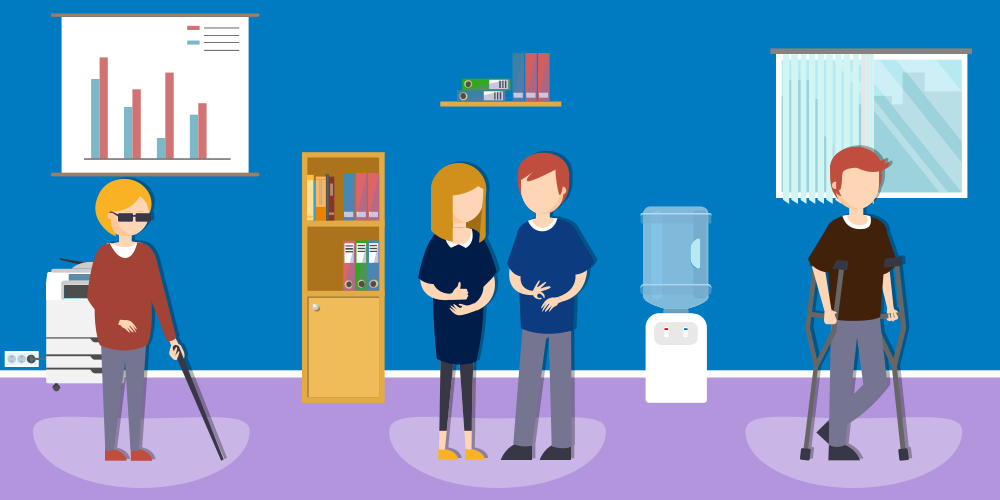
Whether an accommodation is reasonable is decided on a case-by-case basis, with the needs of the particular position in mind.48 Some examples of possible accommodations include the following:
- Allowing an employee to take time off from work for doctor's or therapist's appointments;49
- Allowing an employee a flexible work schedule so they may work more hours on good days and fewer hours when necessary;50
- Restructuring the job description to eliminate non-essential functions;51
- Providing a wheelchair accessible work site, a sign language interpreter, or braille materials;52
- Purchasing or modifying equipment to accommodate an employee's disability;53
- Making facilities readily accessible to and usable by disabled individuals (e.g., providing accessible break rooms, restrooms, training rooms, or reserved parking places);54
- Reassignment to a vacant position;55
- Allowing applicants or employees to bring assistive animals to the work site;56
- Adjusting or modifying examinations, training materials, or policies.57
Medical Leave as an Accommodation
When an employee cannot currently perform the essential functions of the job, or otherwise needs time away from work for treatment and recovery, a leave of absence can itself be a reasonable accommodation. That can mean holding the employee's job open during a leave, or extending a leave provided by the CFRA, the FMLA, other leave laws, or the employer's own leave plan.58
There are limits. The leave must be likely to be effective in allowing the employee to return to work at the end of it, and it must not create an undue hardship for the employer. An employer is also not required to provide an indefinite leave of absence as a reasonable accommodation.59
The reverse is also true: if the employee can keep working with a different reasonable accommodation, the employer cannot force the employee to take a leave of absence instead.60
When the employee returns from an illness, injury, or leave, the employer must individually assess the employee's ability to do the job. Blanket policies requiring an employee to be “100 percent healed” or “fully healed” before returning to work are unlawful.61
And even after a disability has resolved, an employee may still be entitled to accommodations for its residual effects, such as a schedule change to attend follow-up or monitoring appointments with a health care provider.62
Reassignment to a Vacant Position
Sometimes no accommodation will allow the employee to keep performing their current job. If the employee can no longer perform the essential functions of their own position even with an accommodation, or if accommodating them in that position would create an undue hardship, the employer must identify suitable vacant positions through the interactive process and offer the employee those positions for which they are qualified. Reassignment is also an option if the employer and employee agree it is preferable.63
A few rules shape how reassignment works:
- The employee is entitled to preferential consideration for a vacant position over other applicants and existing employees, though the employer ordinarily does not have to override a bona fide seniority system.64
- If there is no comparable vacant position for which the employee is qualified, the employer may reassign the employee to a lower-graded or lower-paid position.65
- The employer is not required to create a new position for the employee, any more than it would create one for an employee without a disability.66
- Reassignment to a temporary position is not itself a reasonable accommodation, but the employer may offer, and the employee may accept or reject, a temporary assignment during the interactive process.67
Requesting a Reasonable Accommodation

In some cases, employers are legally required to proactively offer disabled employees a reasonable accommodation, even if the employee has made no request for an accommodation.68 However, in many other cases the employee has the responsibility to initiate the process by requesting reasonable accommodations.69
If an employee needs an accommodation, it is often advisable to provide a written notice to their employer that does the following:
- Tells the employer that the employee has a disability,
- Explains how the disability interferes with their job functions, and
- Explains which accommodations are needed in order to perform the job's essential functions.
Although the request can be made orally, it is almost always better to put the request in writing and to keep a copy of the notice so there is a record of it.
What documentation can an employer request?
If an employee uses a wheelchair, the need for an accommodation is obvious.70 But if the disability is not obvious, an employer can ask the employee for reasonable medical supporting documentation.71
The employee must be able to provide the employer with a list of restrictions that must be met to accommodate them.72 But this request for documentation does not entitle the employer to seek the employee's entire medical record.73
Things to Consider Before Making a Request
- Employees should first thoroughly discuss their disability with their doctor to understand what their medical limitations are, and what they imply in the workplace.
- Although it is customary that the employee and employer will communicate directly with each other, certain unusual circumstances may justify requiring the employer to communicate through a third party.74
- Some employers have an employee handbook. If one exists, employees should review it and follow any guidelines in it to request a reasonable accommodation.
- The employer does not have to provide the exact requested accommodation, but must have meaningful discussions with the employee about what will work and what is reasonable.75
- The employer may select a less expensive alternative as long as it is appropriate and meets the employee's needs.76
- The employer cannot require the employee to accept an accommodation, and cannot retaliate against the employee for declining one. The employer may, however, warn the employee that declining an accommodation could leave them unable to perform the essential functions of the position.77
- Employees should work diligently and in good faith to find a reasonable accommodation that allows the performance of all essential functions of the job.78
Employers Cannot Disclose the Disability
Although the employee may be required to provide documentation of their disability, they still have a right to privacy.
If the employee chooses to remain private about their condition, the only people who should know about the employee's disability are managers or supervisors who require knowledge of the illness to meet the employee's work restrictions, or first aid and safety personnel where the condition might require emergency treatment.79 Government officials investigating the employer's compliance with the law may also be given relevant information if they request it.80
Any other disclosure of the employee's medical information is unlawful. Medical information and records obtained as part of the interactive process must be maintained separate from the employee's personnel file and kept confidential.81
Furthermore, it is unlawful for the employer or any other person to harass the employee because of the employee's medical condition, physical disability, or mental disability. The employer must also make reasonable efforts to prevent harassment from occurring or can be responsible for financial damages.82
Retaliation is Prohibited
Employees are often worried about the consequences of disclosing a disability and asking for reasonable accommodations. But it is important to understand that both California and federal employment laws protect individuals who request accommodations for their disability.
Retaliation is strictly prohibited.83 Even if the employee's requested accommodation is ultimately denied, an employer may not retaliate or discriminate against an employee for requesting the accommodation.84
Employers who wrongfully terminate or take adverse action against their employees can be liable for any financial or emotional harm they cause.85
Some common examples of unlawful retaliation and discrimination are wrongful termination, reducing an employee's working hours, unjustified poor performance reviews, or any other attempt to force job resignation.
How to Handle Violations
If an employee (or a job applicant) believes they have been discriminated against or denied reasonable accommodation for their disability, they have several options:
- Consider discussing the issue with an attorney to determine the best approach for their specific situation.
- Try to resolve the dispute informally with the immediate supervisor or someone higher up the chain of command.
- Contact the employer's human resource representative or the person in charge of accommodation issues.
- File a formal complaint against the employer with the state's civil rights agency. Or, if that doesn't work out, file a lawsuit in court.
The agency that handles these complaints in California is the Civil Rights Department (CRD), formerly known as the Department of Fair Employment and Housing (DFEH).86 A complaint can be filed online through the CRD's California Civil Rights System (CCRS), or by mail, email, or phone.87
It is important that an employee or job applicant keep in mind that there are strict deadlines they need to meet to file a complaint. In most cases it must be filed within three years from the date of harm.88
Employees who would rather go straight to court can ask the CRD for an immediate right-to-sue notice instead of an investigation.89 Once the CRD issues a right-to-sue notice, the employee has one year from the date of the notice to file their lawsuit.90
Employees who prove a violation can recover compensation for their financial losses (like lost wages and out-of-pocket expenses) and for their emotional harm, and a court can order remedies like reinstatement. A court may also award a winning employee their attorney's fees and costs.91 A losing employee, on the other hand, normally does not have to pay the employer's fees unless the lawsuit was frivolous.92
Of course, the best way to resolve a failure-to-accommodate dispute will depend on the employee's specific situation. It's usually a good idea to get the opinion of a lawyer before deciding how to proceed.
References
- Gov. Code, § 12940, subd. (m)(1) [“It is an unlawful employment practice . . . [f]or an employer or other entity covered by this part to fail to make reasonable accommodation for the known physical or mental disability of an applicant or employee.”].↥
- Nealy v. City of Santa Monica (2015) 234 Cal.App.4th 359, 373.↥
- Cal. Code of Regs., tit. 2, § 11065, subd. (p)(2)(A).↥
- Cal. Code of Regs., tit. 2, §§ 11065, subd. (p)(2)(M), 11068, subd. (c).↥
- Cal. Code of Regs., tit. 2, § 11065, subd. (p)(2)(L).↥
- Cal. Code of Regs., tit. 2, § 11065, subd. (p)(2)(G).↥
- Cal. Code of Regs., tit. 2, § 11065, subd. (p)(2)(B).↥
- Gov. Code, § 12940, subd. (m)(1) [making it unlawful for “an employer or other entity covered by this part to fail to make reasonable accommodation for the known physical or mental disability of an applicant or employee.”].↥
- Gov. Code, § 12940, subd. (a).↥
- Known as the Fair Employment and Housing Act, or “FEHA.”↥
- Gov. Code, § 12926, subd. (d) [“'Employer' includes any person regularly employing five or more persons, or any person acting as an agent of an employer, directly or indirectly, the state or any political or civil subdivision of the state, and cities, except as follows: 'Employer' does not include a religious association or corporation not organized for private profit.”].↥
- Prilliman v. United Air Lines, Inc. (1997) 53 Cal.App.4th 935, 950–951 [employer had an affirmative duty to offer other job opportunities once it knew about the employee's disability]; Cal. Code of Regs., tit. 2, § 11068, subd. (a).↥
- Gov. Code, § 12940, subd. (n); Cal. Code of Regs., tit. 2, § 11069, subd. (a).↥
- Prilliman v. United Air Lines, Inc. (1997) 53 Cal.App.4th 935, 949–950; Cal. Code of Regs., tit. 2, § 11069, subd. (b)(2).↥
- Cal. Code of Regs., tit. 2, §§ 11065, subd. (r), 11068, subds. (a), (e).↥
- Gov. Code, § 12940, subd. (n); Cal. Code of Regs., tit. 2, § 11069.↥
- Wilson v. County of Orange (2009) 169 Cal.App.4th 1185, 1195.↥
- Cal. Code of Regs., tit. 2, § 11068, subd. (e).↥
- Cal. Code of Regs., tit. 2, § 11069, subd. (a); Gov. Code, § 12940, subd. (n) [making it unlawful for an employer to “fail to engage in a timely, good faith, interactive process with the employee or applicant to determine effective reasonable accommodations, if any, in response to a request for reasonable accommodation by an employee or applicant with a known physical or mental disability or known medical condition.”].↥
- Gov. Code, § 12940, subd. (a)(1) [“This part does not prohibit an employer from refusing to hire or discharging an employee with a physical or mental disability . . . if the employee, because of a physical or mental disability, is unable to perform the employee's essential duties even with reasonable accommodations . . . .”].↥
- Gov. Code, § 12926, subd. (f)(1); Cal. Code of Regs., tit. 2, § 11065, subd. (e)(1)(A); Lui v. City and County of San Francisco (2012) 211 Cal.App.4th 962, 972.↥
- Cal. Code of Regs., tit. 2, § 11065, subd. (e)(2).↥
- Gov. Code, § 12940, subd. (m).↥
- Cal. Code of Regs., tit. 2, § 11068, subd. (a) [“An employer or other covered entity has an affirmative duty to make reasonable accommodation(s) for the disability of any individual applicant or employee if the employer or other covered entity knows of the disability, unless the employer or other covered entity can demonstrate, after engaging in the interactive process, that the accommodation would impose an undue hardship.”].↥
- Gov. Code, § 12926, subd. (u) [“'Undue hardship' means an action requiring significant difficulty or expense . . . .”].↥
- Gov. Code, § 12926, subd. (u); Cal. Code of Regs., tit. 2, § 11065, subd. (r) [“'Undue hardship' means, with respect to the provision of an accommodation, an action requiring significant difficulty or expense incurred by an employer or other covered entity, when considered under the totality of the circumstances in light of the following factors: . . . .”].↥
- Gov. Code, § 12926, subds. (j), (m); Cal. Code of Regs., tit. 2, § 11065, subds. (d)(1), (2).↥
- Gov. Code, § 12926, subds. (j)(1)(B) [“A mental or psychological disorder or condition limits a major life activity if it makes the achievement of the major life activity difficult.”], (m)(1)(B)(ii) [“A physiological disease, disorder, condition, cosmetic disfigurement, or anatomical loss limits a major life activity if it makes the achievement of the major life activity difficult.”].↥
- Cal. Code of Regs., tit. 2, § 11065, subd. (l)(3)(E).↥
- Gov. Code, § 12926, subd. (m)(1)(B)(iii).↥
- Gov. Code, § 12926, subd. (m)(1)(B)(iii) [“'Major life activities' shall be broadly construed and includes physical, mental, and social activities and working.”]; Cal. Code of Regs., tit. 2, § 11065, subd. (l)(1).↥
- Gov. Code, § 12940, subd. (m)(1) [“It is an unlawful employment practice . . . [f]or an employer or other entity covered by this part to fail to make reasonable accommodation for the known physical or mental disability of an applicant or employee.”].↥
- Gov. Code, § 12926, subd. (m)(1); Soria v. Univision Radio Los Angeles, Inc. (2016) 5 Cal.App.5th 570, 584; Colmenares v. Braemar Country Club, Inc. (2003) 29 Cal.4th 1019, 1026.↥
- Gov. Code, § 12926, subd. (m).↥
- Gov. Code, § 12926, subds. (j)(1)(A), (m)(1)(B)(i) [“'Limits' shall be determined without regard to mitigating measures such as medications, assistive devices, prosthetics, or reasonable accommodations, unless the mitigating measure itself limits a major life activity.”]; Cal. Code of Regs., tit. 2, § 11065, subd. (l)(3)(C).↥
- Gov. Code, § 12926, subd. (j); Cal. Code of Regs., tit. 2, § 11065, subd. (d)(1).↥
- Gov. Code, § 12926, subd. (j); Cal. Code of Regs., tit. 2, § 11065, subd. (d)(1).↥
- Gov. Code, § 12926, subd. (i); Cal. Code of Regs., tit. 2, § 11065, subd. (d)(7).↥
- Cal. Code of Regs., tit. 2, § 11065, subd. (d)(7); Gov. Code, § 12940, subd. (n).↥
- Gov. Code, § 12926, subds. (j) [the exclusions appear in the subdivision's closing paragraph], (m)(6); Cal. Code of Regs., tit. 2, § 11065, subds. (d)(9)(A) [“'Disability' does not include: . . . compulsive gambling, kleptomania, pyromania, or psychoactive substance use disorders resulting from the current unlawful use of controlled substances or other drugs, and 'sexual behavior disorders' . . . .”], (q).↥
- Cal. Code of Regs., tit. 2, § 11071, subd. (d)(2)(B) [“Individuals who were addicted to drugs, but are not currently using illegal drugs are protected under the FEHA from discrimination because of their disability.”].↥
- Ross v. RagingWire Telecommunications, Inc. (2008) 42 Cal.4th 920, 926 [“The FEHA does not require employers to accommodate the use of illegal drugs.”]; see also Gov. Code, § 12954, subd. (d) [the statute does not permit an employee “to possess, to be impaired by, or to use, cannabis on the job”].↥
- Gov. Code, § 12954, subd. (a)(1), as added by Stats. 2022, ch. 392 (AB 2188) and amended by Stats. 2023, ch. 408 (SB 700).↥
- Gov. Code, § 12954, subd. (b).↥
- Gov. Code, § 12954, subds. (a)(2), (e), (f).↥
- Gov. Code, § 12954, subd. (d).↥
- Gov. Code, § 12945; Cal. Code of Regs., tit. 2, § 11035 et seq.↥
- Hanson v. Lucky Stores, Inc. (1999) 74 Cal.App.4th 215, 228, fn. 11 [“the reasonableness of an accommodation is generally a factual question”].↥
- Cal. Code of Regs., tit. 2, §§ 11065, subd. (p)(2)(M), 11068, subds. (c), (g).↥
- 42 U.S.C. § 12111(9); Gov. Code, § 12926, subd. (p)(2); Cal. Code of Regs., tit. 2, § 11065, subd. (p)(2)(F).↥
- Cal. Code of Regs., tit. 2, § 11065, subd. (p)(2)(E).↥
- Cal. Code of Regs., tit. 2, § 11065, subds. (p)(2)(A), (p)(2)(D).↥
- Cal. Code of Regs., tit. 2, § 11065, subd. (p)(2)(A).↥
- Cal. Code of Regs., tit. 2, § 11065, subd. (p)(2)(A).↥
- Cal. Code of Regs., tit. 2, § 11065, subd. (p)(2)(N).↥
- Cal. Code of Regs., tit. 2, § 11065, subd. (p)(2)(B).↥
- Cal. Code of Regs., tit. 2, § 11065, subd. (p)(2)(H).↥
- Cal. Code of Regs., tit. 2, § 11068, subd. (c).↥
- Cal. Code of Regs., tit. 2, § 11068, subd. (c).↥
- Cal. Code of Regs., tit. 2, § 11068, subd. (c) [“When an employee can work with a reasonable accommodation other than a leave of absence, an employer may not require that the employee take a leave of absence.”].↥
- Cal. Code of Regs., tit. 2, § 11068, subd. (i).↥
- Cal. Code of Regs., tit. 2, § 11068, subd. (g).↥
- Cal. Code of Regs., tit. 2, § 11068, subd. (d)(1).↥
- Cal. Code of Regs., tit. 2, § 11068, subd. (d)(5).↥
- Cal. Code of Regs., tit. 2, § 11068, subd. (d)(2).↥
- Cal. Code of Regs., tit. 2, § 11068, subd. (d)(4).↥
- Cal. Code of Regs., tit. 2, § 11068, subd. (d)(3).↥
- Prilliman v. United Air Lines, Inc. (1997) 53 Cal.App.4th 935, 949–950; Cal. Code of Regs., tit. 2, § 11069, subd. (b)(2).↥
- Gov. Code, § 12940, subd. (n).↥
- Scotch v. Art Institute of California-Orange County, Inc. (2009) 173 Cal.App.4th 986, 1013; Cal. Code of Regs., tit. 2, § 11069, subd. (c)(2).↥
- Cal. Code of Regs., tit. 2, § 11069, subd. (d) [“The applicant or employee shall cooperate in good faith with the employer or other covered entity, including providing reasonable medical documentation where the disability or the need for accommodation is not obvious and is requested by the employer or other covered entity . . . .”].↥
- Jensen v. Wells Fargo Bank (2000) 85 Cal.App.4th 245, 266 [“It is an employee's responsibility to understand his or her own physical or mental condition well enough to present the employer at the earliest opportunity with a concise list of restrictions which must be met to accommodate the employee.”]; Cal. Code of Regs., tit. 2, § 11069, subd. (d)(1) [disclosure of the nature of the disability is not required].↥
- Gov. Code, § 12940, subds. (e)(1), (f)(1); Cal. Code of Regs., tit. 2, §§ 11069, subd. (d)(5)(B) [the employer “shall not ask for unrelated documentation, including in most circumstances, an applicant's or employee's complete medical records”], 11071, subds. (a), (b), (d).↥
- See, e.g., Claudio v. Regents of the University of California (2005) 134 Cal.App.4th 224, 247–248; Cal. Code of Regs., tit. 2, § 11069, subd. (d)(4) [direct communications are preferred, but not required].↥
- Hanson v. Lucky Stores, Inc. (1999) 74 Cal.App.4th 215, 228 [“[T]he employer providing the accommodation has the ultimate discretion to choose between effective accommodations, and may choose the less expensive accommodation or the accommodation that is easier for it to provide.” (Quotation marks omitted.)], quoting Hankins v. The Gap, Inc. (6th Cir. 1996) 84 F.3d 797, 800–801; Cal. Code of Regs., tit. 2, § 11068, subd. (e).↥
- Hanson v. Lucky Stores, Inc. (1999) 74 Cal.App.4th 215, 228.↥
- Cal. Code of Regs., tit. 2, § 11068, subd. (f).↥
- Gelfo v. Lockheed Martin Corp. (2006) 140 Cal.App.4th 34, 54; Cal. Code of Regs., tit. 2, § 11069, subd. (d).↥
- Cal. Code of Regs., tit. 2, § 11069, subds. (g)(1), (2).↥
- Cal. Code of Regs., tit. 2, § 11069, subd. (g)(3).↥
- Cal. Code of Regs., tit. 2, § 11069, subd. (g).↥
- Gov. Code, § 12940, subds. (j)(1), (k); Roby v. McKesson Corp. (2009) 47 Cal.4th 686, 706.↥
- Gov. Code, § 12940, subd. (m)(2).↥
- Gov. Code, § 12940, subd. (m)(2) [making it unlawful for an employer to “retaliate or otherwise discriminate against a person for requesting accommodation under this subdivision, regardless of whether the request was granted.”]; Cal. Code of Regs., tit. 2, § 11068, subd. (k).↥
- Gov. Code, § 12940, subds. (h), (m)(2); Cal. Code of Regs., tit. 2, § 11021, subd. (a); Diego v. Pilgrim United Church of Christ (2014) 231 Cal.App.4th 913, 923.↥
- Gov. Code, § 12930; see CRD, Complaint Process.↥
- CRD, Complaint Process.↥
- Gov. Code, § 12960, subd. (e)(5).↥
- Gov. Code, § 12965, subd. (c)(1)(A).↥
- Gov. Code, § 12965, subd. (c)(1)(D).↥
- Gov. Code, §§ 12926, subd. (a), 12965, subd. (c)(6).↥
- Gov. Code, § 12965, subd. (c)(6) [a prevailing employer may recover fees only on a finding that the action was frivolous, unreasonable, or groundless].↥