Lactation Break Law in California: The Right to Pump at Work
California employers must give nursing mothers reasonable break time and a private, compliant space to pump, with real penalties for violations.


- Last updated
- Reading time
- 13 min
A lactation break is a period of time during the work day for nursing mothers to express breast milk (i.e., a break to pump). All California employers are required to permit new mothers to take a reasonable amount of break time to express breast milk each time they need to pump,1 and to provide a private lactation space that meets specific legal requirements.2 These rights are subject to two narrow exceptions:
- Serious Disruptions. An employer is not required to provide lactation break time when doing so would seriously disrupt its operations.3 The law does not define what a serious disruption means. It is most likely to exist where the employer incurs significant difficulty or expense because of their size, financial resources, or the specific circumstances of the business.4
- Non-Infant Children. The right to take lactation breaks only exists for employees expressing breast milk for their own infant child.5 California law contains no bright-line rule about how young a child must be to be considered an infant. By comparison, the federal right lasts for one year after the child's birth.6 Because California's statute has no express time limit, courts are likely to find that the right to take lactation breaks lasts at least one year, and maybe even up to two or three years.7
Importantly, the “serious disruptions” exception excuses only the break time. It does not excuse the duty to provide a compliant lactation space, although an employer with fewer than 50 employees can be exempted from a specific space requirement by demonstrating an undue hardship.8
Courts in California tend to be very hesitant to deny women their lactation breaks. So employers should be cautious before claiming that either one of these exceptional circumstances applies.
The remainder of this article will explore the legal intricacies of lactation break rights in California.
Why the Right to Pump at Work Matters
Studies suggest that there are many benefits to breastfeeding. For mothers, breastfeeding provides a valuable opportunity to bond with their newborn. For children, there are numerous health and developmental benefits, including:
- Increased immunity to disease,
- Reduced risk of infections,
- Reduced risk of diabetes,
- Reduced risk of childhood obesity,
- Better mental health through adolescence,
- Reduced allergies, and
- Possibly increased intelligence.9
Given these health benefits, it wouldn’t be fair for employers to make this important parental decision for their workers. Accordingly, both federal and state laws protect a mother’s right to express breast milk at work under certain conditions.
When, Where, and How Lactation Breaks Are Taken
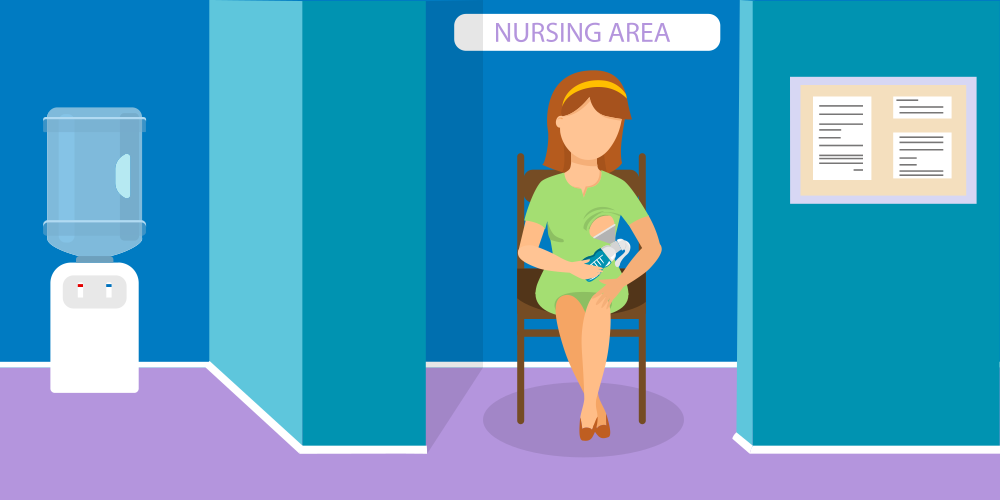
The length of the lactation break must be a reasonable amount of time to express breast milk.10 This somewhat vague standard usually means that there are no strict time limits.
The U.S. Department of Labor has suggested that the act of expressing breast milk alone typically takes about 15 to 20 minutes, but a reasonable break time will usually be longer because the employee will likely require preparation before beginning.11
The appropriate length of the break will depend on a variety of factors. Those include:
- The frequency and number of breaks the nursing mother might need;
- The time it takes to walk to and from the lactation space and the wait, if any, to use the space;
- The time it takes the employee to retrieve her pump and other supplies from another location;
- The time it takes the employee to unpack and set up her own pump or if a pump is provided for her;
- The efficiency of the pump used to express milk (employees using different pumps may require more or less time);
- The time it takes the employee to wash her hands before pumping and to clean the pump attachments when she is done expressing milk; and
- The time it takes for the employee to store her milk either in a refrigerator or personal cooler.12
Scheduling Lactation Breaks
If the employee is entitled to take rest or meal breaks, the employee should try to take the lactation break at the same time as the rest or meal breaks.13 But if that isn't possible, or if the employee requires additional break time to express milk, the employer is still required to allow the lactation breaks at other times.14
Lactation Break Locations
Employers are required to provide employees with the use of a room or other location to express breast milk in private.15 The lactation space may not be a bathroom, and it must be in close proximity to the employee's work area, shielded from view, and free from intrusion while the employee is expressing milk.16
The lactation space must also meet all of the following requirements:17
- Be safe, clean, and free of hazardous materials;
- Contain a surface to place a breast pump and personal items;
- Contain a place to sit; and
- Have access to electricity, or to alternative devices like extension cords or charging stations, needed to operate an electric or battery-powered breast pump.
In addition, the employer must provide access to a sink with running water and a refrigerator suitable for storing milk in close proximity to the employee's workspace. If a refrigerator cannot be provided, the employer may provide another cooling device suitable for storing milk, such as an employer-provided cooler.18
If the employee's normal work area is private and otherwise compliant, the employer is allowed to designate that area as the place for the employee to express their breast milk.19 A multipurpose room can also serve as the lactation space, but its use for lactation takes precedence over its other uses for as long as it is being used for lactation.20 And an employer with operational, financial, or space limitations may designate a temporary lactation space, as long as it is not a bathroom, is close to the employee's work area, is private, and otherwise complies with the law.21
Special rules apply to a few kinds of worksites. An employer in a multitenant building or multiemployer worksite that cannot provide a lactation location within its own workspace may comply by providing a space shared among the employers there.22 And an agricultural employer complies by providing a private, enclosed, and shaded space, such as an air-conditioned cab of a truck or tractor.23
Employees who work remotely have the same rights. Under federal guidance, an employee who works from home must be free to pump without being watched through any employer-provided or employer-required video system, such as a computer camera, security camera, or web conferencing platform.24
Finally, an employer with fewer than 50 employees can be exempted from a specific space requirement if it demonstrates that the requirement would impose an undue hardship.25 Even then, the employer must make reasonable efforts to provide the employee with the use of a private space, other than a toilet stall, in close proximity to the employee's work area.26
Some California cities also impose additional lactation accommodation requirements. San Francisco, for example, has its own Lactation in the Workplace Ordinance, with policy, response, recordkeeping, and lactation-space rules that go beyond state law, enforced by the city's Office of Labor Standards Enforcement.27
How to Request Lactation Breaks
If new mothers desire to express breast milk at work, they should notify their employer of the need to do so. It is usually a good idea to put the request in writing, using respectful but concise language.
Employers are also required to maintain a written lactation accommodation policy. The policy must describe the employee's right to request a lactation accommodation, the process for making the request, the employer's obligation to respond, and the employee's right to file a complaint with the Labor Commissioner.28 The policy must be included in the employee handbook or the employer's set of policies, and it must be distributed to new hires and to any employee who asks about parental leave.29
If the employer cannot provide compliant break time or a compliant location, it must respond to the employee in writing.30 Employees should keep a copy of that response, along with a copy of their own request.
Employers are legally prohibited from retaliating against employees who request a lactation break or otherwise exercise their lactation break rights.31 This means that an employee cannot be punished, fired, or treated unfairly for exercising the right to a lactation break.
Pay During Lactation Breaks
If the employee takes their lactation breaks at times other than their normal rest or meal breaks, the employer is not required to pay the employee during the lactation break.32
If the lactation break occurs at the same time that a paid break would otherwise occur for the employee, the break must be paid.33
The employee must also be paid for the break if they are not completely relieved of their work duties while pumping.34 In other words, an employee who keeps working while expressing milk is on paid time.
Here is how the two laws compare on the key points:
| Topic | California (Labor Code) | Federal (PUMP Act) |
|---|---|---|
| Covered employers | All employers, including the state and political subdivisions | Employers covered by the FLSA; employers with fewer than 50 employees may claim an undue-hardship exemption |
| How long the right lasts | No express time limit; applies while expressing milk for an “infant child” | One year after the child's birth |
| Lactation space | Not a bathroom; close to the work area; shielded from view; free from intrusion; safe and clean; surface, seat, and electricity; sink and refrigerator close by | Not a bathroom; shielded from view; free from intrusion |
| Pay | Unpaid if taken separately from paid breaks; paid if concurrent with a paid break | Unpaid unless the employee keeps working or another law requires pay |
| Enforcement | One hour of premium pay per day of violation; Labor Commissioner citations of $100 per day | Wage and Hour Division complaint or private lawsuit; 10-day notice rule for space violations |
| See Labor Code, §§ 1030–1034; 29 U.S.C. § 218d. | ||
Direct Breastfeeding in Public and at Work

In California, mothers have a right to breastfeed their child in any location, public or private.35 To exercise this right, the mother and child must be:
- Authorized to be in the location where they wish to breastfeed, and
- Somewhere other than the private home or residence of another person.36
This law strongly suggests that, if an employer allows children in the workplace or provides for on-site daycare, the employer must permit their employee to use their lactation breaks for the purpose of breastfeeding, rather than pumping.37
Importantly, however, employers do not have a legal obligation to permit parents to bring their children to work. Nor do California employers have an obligation to provide daycare facilities for working parents. So the right to directly breastfeed children at work is limited in application.
It should also be noted that California courts have not directly addressed the overlap between the right to breastfeed in public and the right to take lactation breaks. So, although the law seems to indicate that direct breastfeeding is a right for mothers who have their children at work, it isn't entirely clear.
The Duty to Accommodate Breastfeeding Mothers
As mentioned above, employers are required to provide employees with a private lactation space that meets specific legal requirements, along with reasonable break time to use it.38 But California law also requires many employers to take additional steps to accommodate breastfeeding.
Employers in California with five or more employees are legally required to provide reasonable accommodations for employees with a condition related to pregnancy or childbirth.39 A reasonable accommodation is an adjustment to the employee’s work environment that can enable the employee to perform the essential functions of the job.40
For these purposes, lactation is a condition related to pregnancy or childbirth.41 As such, employers are required to accommodate the employee's lactation-related needs. Notably, at least one court has held that this accommodation right is not limited to employees who are expressing milk for their own infant child.42
Reasonable accommodations for lactating mothers will often include transferring the employee to a less strenuous or hazardous position.43 They might also include allowing the mother to work from home.
Federal law now imposes a similar duty. Under the Pregnant Workers Fairness Act, which took effect in 2023, employers with 15 or more employees must provide reasonable accommodations for an employee's known limitations related to pregnancy, childbirth, or related medical conditions, unless doing so would impose an undue hardship.44 Lactation is among the conditions that can require accommodation under this law.45
To exercise this right under California law, the employee must request the accommodation with the advice of her health care provider.46 It is usually a good idea to put the requests in writing, and to save a copy of the request.
Employers are prohibited from retaliating against employees who request an accommodation for a condition related to pregnancy or breastfeeding.47 This is true even if the requested accommodation is ultimately denied. In other words, an employee cannot be punished, fired, or treated unfairly for seeking an accommodation.
Discrimination Related to Lactation Breaks
In California, it is unlawful for an employer with five or more employees to discriminate against an employee on the basis of their sex.48
For these purposes, sex is defined to include breastfeeding or medical conditions related to breastfeeding.49 As such, employers of five or more employees are prohibited from discriminating against employees for reasons related to breastfeeding.50
Likewise, employers are prohibited from harassing women for reasons related to breastfeeding.51 The protections against workplace harassment are broader than those against discrimination: they apply regardless of the employer's size,52 and they cover women who aren't technically employees.53
The result of these laws is that women may not be treated unfairly or improperly because they desire to breastfeed, take lactation breaks, or pump (whether at home or work).54 Related guideWorkplace Breastfeeding Laws in CaliforniaA broader look at the employment rights of breastfeeding mothers in California, including discrimination and accommodation claims.
Using Leave Time from Work for Breastfeeding

Many working mothers have a right to enjoy certain periods of unpaid leave time as a matter of law. In the context of pregnancy and breastfeeding, the main two types of leave are as follows:
- Up to 12 weeks of leave to bond with the child,55 and
- Up to four months of pregnancy disability leave.56
An employee's right to these types of leave will depend on a variety of factors, including how long they have worked for their employer, how many employees the employer has, and how many hours the employee has worked in the past year for the employer.57 Both types of leave now apply to employers with five or more employees.58
But, if an employee has a right to both types of leave, they can be applied cumulatively.59 This means that an employee might be entitled to nearly seven months of total leave time during or after their pregnancy.60
Importantly, the two types of leave serve very different purposes. If an employee is entitled to receive leave to bond with their child, they have a right to take that leave regardless of whether they are breastfeeding.61
In contrast, pregnancy disability leave is only available to women who have been disabled by the pregnancy or childbirth in some way.62 In general, lactation is not a disabling condition for these purposes.63
So an employee cannot usually use pregnancy disability leave to breastfeed. If, however, the worker has medical complications related to lactation, they may have a right to use pregnancy disability leave for purposes related to breastfeeding.64
It is also possible that, if an employee is disabled by a condition related to breastfeeding or lactation, their employer will be required to provide them with time off in addition to their four months of pregnancy disability leave to accommodate their disability.65
These rights are explained further in our article: Maternity Leave Law in California.
Consequences of Violating Lactation Break Laws

If an employer denies an employee reasonable break time or an adequate space to express milk, the denial is treated as a failure to provide a rest period. The employee is therefore entitled to one additional hour of pay at their regular rate of compensation for each workday of the violation.66 The employee can recover that pay by filing a wage claim with the Labor Commissioner or by filing a lawsuit.67
Employees can also report violations to the Labor Commissioner's field enforcement unit. After an inspection or investigation, the Labor Commissioner can issue a citation imposing a civil penalty of $100 for each day that the employee was denied reasonable break time or adequate space to express milk.68 In some cases, part of these penalties can be recovered by the employee through a Private Attorneys General Act lawsuit.69
Federal remedies are also available. Since April 28, 2023, employees can recover the full range of remedies under the Fair Labor Standards Act for violations of the federal break time and space requirements, either by filing a complaint with the U.S. Department of Labor's Wage and Hour Division or by filing a lawsuit.70 One caution applies: before suing over an employer's failure to provide a compliant space, the employee generally must notify the employer and give it 10 days to come into compliance. That notice is not required if the employee was fired for requesting break time or a space, or if the employer has made clear that it has no intention of providing one.71
Similarly, if the employer discriminates against a breastfeeding employee, they can be held liable for substantial damages. Those damages might include:
- Compensatory Damages. Money to compensate the mother for any harm she suffered. Examples of this type of relief include money for lost wages, unpaid wages, or medical expenses.72
- Punitive Damages. Money to punish the employer for their wrongful actions. These are especially likely if the employer retaliated against the employee for enforcing their breastfeeding-related rights.73
Clearly, a violation of California's laws that protect nursing mothers can be costly. It is usually best for employers to play it safe and accommodate nursing mothers to the greatest extent possible.
How to Handle a Violation of Lactation Break Rights

Victimized employees have several options. Depending on the type of right that was violated, those options usually include:
- Resolve the dispute informally with the employer,
- File a complaint with an administrative agency, or
- File a civil lawsuit.
The best course will depend on a number of factors specific to the employee's situation, including the type of right that was violated and the extent of the employee's suffering. In general, violations of the lactation break and space requirements are handled by the Labor Commissioner, while discrimination, harassment, and accommodation claims begin with an intake filed with California's Civil Rights Department (CRD).76
Importantly, employers are generally prohibited from retaliating against employees who exercise or seek to enforce their rights.77 As such, employees cannot be punished, fired, or treated unfairly for reporting violations of their breastfeeding rights. And if an employer takes an adverse action within 90 days of the employee's protected activity, the law presumes the action was retaliatory, and the employer must rebut that presumption.78
It is often a good idea to have an employment attorney assist with pursuing these options. They can evaluate the type of claim, recommend the best course of action, and negotiate the matter on the employee's behalf.
Importantly, however, the deadline to file claims is often short. A wage claim for the missed-break premium generally must be filed within three years.79 A discrimination or harassment claim must be filed with the Civil Rights Department within three years of the violation, and any lawsuit must be filed within one year of receiving a right-to-sue notice.80 So it is usually a good idea for employees to act fast if they wish to enforce their rights.
References
- Labor Code, § 1030 [“Every employer, including the state and any political subdivision, shall provide a reasonable amount of break time to accommodate an employee desiring to express breast milk for the employee's infant child each time the employee has need to express milk.”].↥
- Labor Code, § 1031; see also 29 U.S.C. § 218d [the parallel federal requirement, which applies to employers of all sizes, although an employer with fewer than 50 employees may be exempt if compliance would impose an undue hardship].↥
- Labor Code, § 1032 [“An employer is not required to provide break time under this chapter if to do so would seriously disrupt the operations of the employer.”].↥
- See, e.g., Labor Code, § 1031, subd. (i) [“An employer that employs fewer than 50 employees may be exempt from a requirement of this section if it can demonstrate that a requirement would impose an undue hardship by causing the employer significant difficulty or expense when considered in relation to the size, financial resources, nature, or structure of the employer's business.”]; 29 U.S.C. § 218d(c) [stating the same standard under federal law]; Gov. Code, § 12926, subd. (u) [“'Undue hardship' means an action requiring significant difficulty or expense . . . .”].↥
- Labor Code, § 1030.↥
- 29 U.S.C. § 218d(a)(1) [requiring “a reasonable break time for an employee to express breast milk for such employee's nursing child for 1 year after the child's birth each time such employee has need to express the milk”].↥
- See, e.g., Bauman v. Beaujean (1966) 244 Cal.App.2d 384, 388 [suggesting a child younger than 3½ years old might be considered an “infant”].↥
- Compare Labor Code, § 1032 [break-time exception], with Labor Code, § 1031, subd. (i) [space-requirement exemption limited to employers with fewer than 50 employees].↥
- Wikipedia, Breastfeeding.↥
- Labor Code, § 1030 [“Every employer, including the state and any political subdivision, shall provide a reasonable amount of break time to accommodate an employee desiring to express breast milk for the employee's infant child”]; 29 U.S.C. § 218d(a)(1) [“An employer shall provide . . . a reasonable break time for an employee to express breast milk for such employee's nursing child . . . .”].↥
- Reasonable Break Time for Nursing Mothers, 75 Fed.Reg. 80073, 80075 (Dec. 21, 2010).↥
- Reasonable Break Time for Nursing Mothers, 75 Fed.Reg. 80073, 80075 (Dec. 21, 2010); see also U.S. Dept. of Labor, Wage & Hour Div., Fact Sheet #73: Break Time for Nursing Mothers under the FLSA.↥
- Labor Code, § 1030 [“The break time shall, if possible, run concurrently with any break time already provided to the employee.”].↥
- Labor Code, § 1030.↥
- Labor Code, § 1031, subd. (a) [“An employer shall provide an employee with the use of a room or other location for the employee to express milk in private.”].↥
- Labor Code, § 1031, subd. (b); see also 29 U.S.C. § 218d(a)(2) [federal law similarly requires “a place, other than a bathroom, that is shielded from view and free from intrusion from coworkers and the public”].↥
- Labor Code, § 1031, subd. (c); see Labor Code, § 6382 [defining hazardous materials].↥
- Labor Code, § 1031, subd. (d).↥
- Labor Code, § 1031, subd. (a) [“The room or location may include the place where the employee normally works if it otherwise meets the requirements of this section.”].↥
- Labor Code, § 1031, subd. (e).↥
- Labor Code, § 1031, subd. (h).↥
- Labor Code, § 1031, subd. (f)(1).↥
- Labor Code, § 1031, subd. (g).↥
- U.S. Dept. of Labor, Wage & Hour Div., Fact Sheet #73: Break Time for Nursing Mothers under the FLSA [“Workers who telework must also be free from observation by any employer-provided or required video system, including computer camera, security camera, or web conferencing . . . .”].↥
- Labor Code, § 1031, subd. (i).↥
- Labor Code, § 1031, subd. (i) [an exempted employer “shall make reasonable efforts to provide the employee with the use of a room or other location, other than a toilet stall, in close proximity to the employee's work area, for the employee to express milk in private”].↥
- S.F. Labor and Employment Code, art. 31 (Lactation in the Workplace Ordinance); see S.F. Office of Labor Standards Enforcement, Lactation in the Workplace Ordinance.↥
- Labor Code, § 1034, subd. (a).↥
- Labor Code, § 1034, subds. (b), (c).↥
- Labor Code, § 1034, subd. (d).↥
- Labor Code, §§ 1033, subd. (b) [“An employer shall not discharge, or in any other manner discriminate or retaliate against, an employee for exercising or attempting to exercise any right protected under this chapter.”], 98.6, subd. (a).↥
- Labor Code, § 1030 [“Break time for an employee that does not run concurrently with the rest time authorized for the employee by the applicable wage order of the Industrial Welfare Commission shall be unpaid.”]; 29 U.S.C. § 218d(b)(1) [“an employer shall not be required to compensate an employee receiving reasonable break time . . . unless otherwise required by Federal or State law or municipal ordinance”].↥
- See Labor Code, § 1030; Dept. of Industrial Relations, Rest Periods/Lactation Accommodation [rest period time is “counted as time worked” and must be paid].↥
- 29 U.S.C. § 218d(b)(2) [“Break time provided under subsection (a)(1) shall be considered hours worked if the employee is not completely relieved from duty during the entirety of such break.”].↥
- Civil Code, § 43.3.↥
- Civil Code, § 43.3 [“Notwithstanding any other provision of law, a mother may breastfeed her child in any location, public or private, except the private home or residence of another, where the mother and the child are otherwise authorized to be present.”].↥
- Compare Labor Code, § 1030, with Civil Code, § 43.3.↥
- Labor Code, §§ 1030, 1031.↥
- Gov. Code, § 12945, subd. (a)(3)(A) [prohibiting employers from “refus[ing] to provide reasonable accommodation for an employee for a condition related to pregnancy, childbirth, or a related medical condition, if the employee so requests, with the advice of the employee's health care provider”]; Gov. Code, § 12926, subd. (d) [defining a covered employer as one regularly employing five or more persons].↥
- Nealy v. City of Santa Monica (2015) 234 Cal.App.4th 359, 373.↥
- Cal. Code of Regs., tit. 2, § 11035, subd. (d) [“A 'condition related to pregnancy, childbirth, or a related medical condition,' as set forth in Government Code section 12945, means a physical or mental condition intrinsic to pregnancy or childbirth that includes, but is not limited to, lactation.”].↥
- Gonzales v. Marriott Internat., Inc. (C.D. Cal. 2015) 142 F.Supp.3d 961, 965 [employee who continued expressing milk for donation after a gestational surrogacy stated a claim for failure to accommodate a condition related to pregnancy under the Fair Employment and Housing Act].↥
- Cal. Code of Regs., tit. 2, § 11035, subd. (d).↥
- 42 U.S.C. §§ 2000gg–2000gg-6; 42 U.S.C. § 2000gg-1(1) [requiring accommodation of the “known limitations related to the pregnancy, childbirth, or related medical conditions of a qualified employee”]; 42 U.S.C. § 2000gg(2) [adopting the federal Civil Rights Act's definitions, under which private employers are covered if they have 15 or more employees].↥
- 29 C.F.R. pt. 1636 [the Equal Employment Opportunity Commission's regulations implementing the Pregnant Workers Fairness Act, identifying lactation as a related medical condition for which accommodation may be sought].↥
- Gov. Code, § 12945, subd. (a)(3)(A).↥
- Gov. Code, §§ 12945, subd. (a)(4) [making it unlawful “[f]or an employer to interfere with, restrain, or deny the exercise of, or the attempt to exercise, any right provided under this section”], 12940, subd. (m)(2) [prohibiting retaliation for requesting a disability accommodation “regardless of whether the request was granted”].↥
- Gov. Code, §§ 12926, subd. (d) [defining a covered employer as one regularly employing five or more persons], 12940, subd. (a) [defining sex discrimination as a type of unlawful employment practice, unless based upon a bona fide occupational qualification].↥
- Gov. Code, § 12926, subd. (r)(1)(C) [“'Sex' includes, but is not limited to, the following: . . . Breastfeeding or medical conditions related to breastfeeding.”].↥
- Gov. Code, §§ 12926, subd. (r)(1)(C), 12940, subd. (a).↥
- Gov. Code, § 12940, subds. (j)(1) [prohibiting sex harassment of any employee, applicant, unpaid intern, volunteer, or a person providing services pursuant to a contract], (j)(4)(C) [“'harassment' because of sex includes sexual harassment, gender harassment, and harassment based on pregnancy, childbirth, or related medical conditions”].↥
- Gov. Code, § 12940, subd. (j)(4)(A) [“For purposes of this subdivision only, 'employer' means any person regularly employing one or more persons or regularly receiving the services of one or more persons providing services pursuant to a contract, or any person acting as an agent of an employer, directly or indirectly, the state, or any political or civil subdivision of the state, and cities.”].↥
- Gov. Code, § 12940, subd. (j)(1) [applying to employees, applicants, interns, volunteers, and independent contractors].↥
- See also Reasonable Break Time for Nursing Mothers, 75 Fed.Reg. 80073, 80078 (Dec. 21, 2010) [“If an employer treats employees who take breaks to express breast milk differently than employees who take breaks for other personal reasons, the nursing employee may have a claim for disparate treatment under Title VII.”].↥
- See Gov. Code, § 12945.2, subds. (a), (b)(5).↥
- See Gov. Code, § 12945, subd. (a)(1).↥
- Gov. Code, §§ 12945, subd. (a)(1), 12945.2, subds. (a), (b)(4).↥
- Gov. Code, §§ 12926, subd. (d) [pregnancy disability leave], 12945.2, subd. (b)(4) [family care and medical leave, as amended by Stats. 2020, ch. 86 (SB 1383)].↥
- Gov. Code, § 12945.2, subd. (p) [“An employee is entitled to take, in addition to the leave provided for under this section and the FMLA, the leave provided for in Section 12945, if the employee is otherwise qualified for that leave.”].↥
- Gov. Code, §§ 12945, subd. (a)(1), 12945.2, subd. (a).↥
- Gov. Code, § 12945.2, subd. (b)(5).↥
- Gov. Code, § 12945, subd. (a)(1).↥
- Cal. Code of Regs., tit. 2, § 11035, subd. (d) [“Generally lactation without medical complications is not a disabling related medical condition requiring pregnancy disability leave, although it may require transfer to a less strenuous or hazardous position or other reasonable accommodation.”].↥
- Gov. Code, § 12945; Cal. Code of Regs., tit. 2, § 11035, subds. (d), (u) [defining a “related medical condition” to include “lactation-related medical conditions such as mastitis”].↥
- See Sanchez v. Swissport, Inc. (2013) 213 Cal.App.4th 1331, 1339–1341 [holding that an employer's obligations to provide accommodations under the Fair Employment and Housing Act are still required when the employee has exhausted their leave time under the Pregnancy Disability Leave Law].↥
- Labor Code, §§ 1033, subd. (a) [“The denial of reasonable break time or adequate space to express milk in accordance with this chapter shall be deemed a failure to comply for purposes of Section 226.7.”], 226.7, subd. (c); see Ferra v. Loews Hollywood Hotel, LLC (2021) 11 Cal.5th 858, 864 [the “regular rate of compensation” includes hourly wages plus nondiscretionary payments].↥
- Labor Code, § 1033, subd. (a) [an aggrieved employee “may file a complaint under this subdivision with the Labor Commissioner pursuant to Section 98”].↥
- Labor Code, § 1033, subd. (c) [authorizing “a civil penalty in the amount of one hundred dollars ($100) for each day that an employee is denied reasonable break time or adequate space to express milk in violation of this chapter”].↥
- Labor Code, §§ 2698–2699.5 [the Labor Code Private Attorneys General Act of 2004; for actions filed on or after June 19, 2024, aggrieved employees receive 35 percent of recovered civil penalties, subject to the 2024 amendments' penalty caps and cure provisions].↥
- 29 U.S.C. §§ 216(b), 218d; U.S. Dept. of Labor, Wage & Hour Div., Fact Sheet #73: Break Time for Nursing Mothers under the FLSA.↥
- 29 U.S.C. § 218d(g).↥
- Peatros v. Bank of America (2000) 22 Cal.4th 147, 166–167 [the Fair Employment and Housing Act “allows the employee to obtain 'all relief generally available,' specifically 'in noncontractual actions' [citations], including 'unlimited compensatory and punitive damages' [citations]”].↥
- Peatros v. Bank of America (2000) 22 Cal.4th 147, 166–167; see also Labor Code, §§ 98.6, 1102.5, 1197.5 [prohibiting retaliation]; Gov. Code, § 12940, subd. (h) [same].↥
- Gov. Code, § 12965, subd. (c)(6) [“In civil actions brought under this section, the court, in its discretion, may award to the prevailing party, including the department, reasonable attorney's fees and costs, including expert witness fees.”].↥
- Gov. Code, § 12965, subd. (c)(6).↥
- Labor Code, § 1033, subds. (a)–(c); Gov. Code, §§ 12960, 12965.↥
- Labor Code, §§ 98.6, 1033, subd. (b), 1102.5, 1197.5; Gov. Code, § 12940, subd. (h).↥
- Labor Code, §§ 98.6, subd. (b)(1), 1102.5, as amended by Stats. 2023, ch. 612 (SB 497).↥
- Code Civ. Proc., § 338, subd. (a); Murphy v. Kenneth Cole Productions, Inc. (2007) 40 Cal.4th 1094 [the additional hour of pay under section 226.7 is a wage subject to the three-year limitations period].↥
- Gov. Code, §§ 12960, subd. (e)(5), 12965, subd. (c)(1)(D).↥